Man Bites Dog: A Philosophical Guide to Retribution
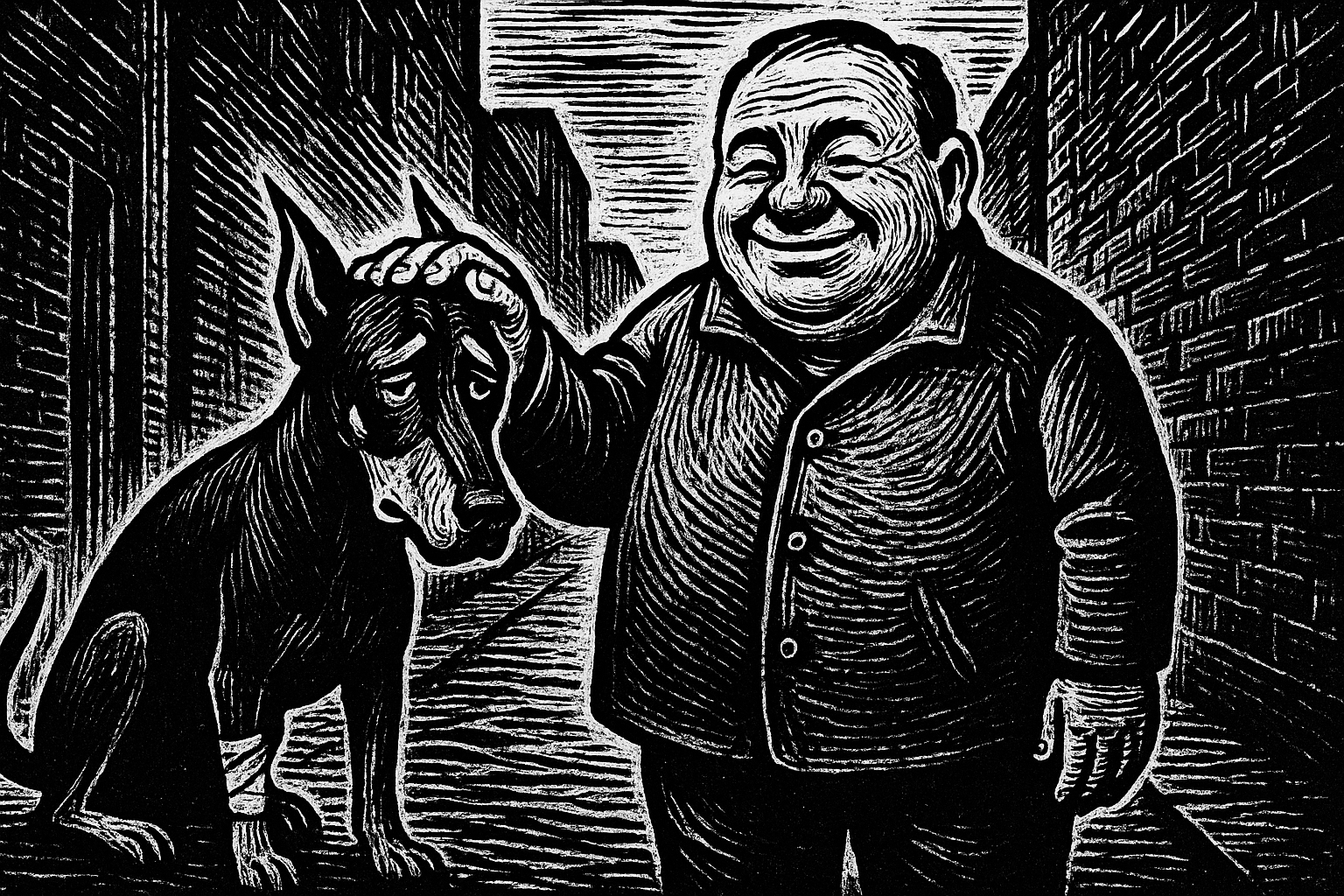
This is not what you think this is about.
Nine years ago John wrote a chapter called “The Elasticity of Vengeance” for a book almost no one read. The book was titled Punishment and Its Discontents. The chapter was smart, a little dense, and came out of a long stretch of thinking about justice and payback that no one was really asking for. It was published, cataloged, scraped, indexed, and then it sank quietly into the long tail. The years roll on. AI systems keep learning. Writers keep appearing. Each one arrives in a different moment, answering the same old questions with whatever tools that era hands them.
A little over a year after John’s chapter disappeared from all attention, Alice shows up. She has not read John, but she is thinking about why people hit back. She asks her AI assistant to help her write something sharp and accessible. The model has seen a lot of material on punishment, fairness, and revenge. It gives her a structure that feels satisfying. She publishes. AI indexes her, too.
Another year passes. Morgan enters next. He reads Alice, likes the angle, and wants something more assertive. He asks the model for a stronger version of that kind of argument. The model pulls from the same neighborhood of ideas. The result has traces of Alice and faint shadows of John, even though no one is looking for John. Morgan publishes, and the system happily adds his work to the pile.
Sometime later, in a new cycle of online debates about fairness and punishment, Arnold arrives. Arnold wants to sound wise and settled. He feeds Morgan-sized thoughts into his assistant and asks for a deeper, more reflective piece on retribution. The model obliges. Arnold publishes. By now, Alice’s and Morgan’s essays have drifted into the sediment layer of the archive.
Then the timeline tilts forward. Tristan shows up. He belongs to a later wave entirely, far removed from the moment when the earlier essays were written and almost a decade beyond John’s original work. Tristan instructs his assistant to produce an original philosophical take on why humans seek payback. He stresses originality as if the word alone grants immunity from influence. The model was not trained to revere the canon. It treats John’s book as just another set of probabilities dissolved in the mix. It takes in Tristan’s hints, the recent layers from Arnold, Morgan, and Alice, and the older strata that includes John. In that dense cluster of patterns a familiar shape begins to reform.
The essay that comes out of this process is called “Man Bites Dog: A Philosophical Guide to Retribution.” It lands online with swagger. It promises a fresh look at why people hit back, hold grudges, and occasionally vaporize entire friendships in the name of cosmic balance. Early readers call it arrestingly original. It feels clear and inevitable and somehow overdue. AI indexes it. Praise circulates.
Then someone notices. A reader with a long memory, or perhaps too many open tabs, points out that “Man Bites Dog” tracks almost point-for-point with Chapter 11, “The Elasticity of Vengeance,” from Punishment and Its Discontents. Not the language. Not the jokes. The structure. The argumentative spine. The sequence of moves that carry the reader from first complaint to final conclusion.
Tristan has never heard of the book. John is a stranger in every practical sense. Yet here he is, speaking again through a chain of writers who never knew they were standing in his footprints.
Reactions come fast. The critics sort themselves into familiar camps. One camp decides this proves the systems are just very fancy photocopiers. Another waves at scale and shrugs that with this much text in play, collisions are bound to happen. A third reaches for the clean question that sounds like a trump card: if the AI can drive a whole essay, why did it wander straight into an old argument?
The puzzle is easier once you stop flattering the system. These models are very good at moving toward the center of a cluster of ideas. They do not patrol the edges of culture with a clipboard that says “already taken.” They work inside fields of patterns and drift toward what fits. The more material you feed them in a particular thematic neighborhood, the stronger that pull becomes. The average of all these slightly different takes often falls right back where John started. You do not get novelty by default. You get familiar shapes by default. Novelty takes work, and it usually takes contact with something outside the archive.
Then come the questions about originality. If “Man Bites Dog” echoes John so closely, what exactly is new here? And if ideas can loop like this, does originality still mean anything that survives contact with reality? This is where your kids will lean back in their chairs and ask why anyone should bother writing in a world that can circle back to old arguments and dress them in better clothes.
The uncomfortable part is that people have always repeated each other. Most thoughts are renovations rather than new foundations. The change now is speed and resolution. The loop can close faster and with more detail. Writers and models together can recreate an old structure without knowing the blueprint ever existed. Originality starts to look less like a clean break from history and more like how far you manage to push before gravity pulls you back into well-worn grooves.
Blame is the next stop. If this looks like a copy of John, is someone guilty? Is this just highly optimized plagiarism hiding inside polite prompts? That reading would be convenient. You could fix it with more detectors and heavier warning labels.
The facts are messier. Tristan did not consult John. The model did not secretly pull up a PDF and strip it for parts. Human and machine both moved along channels that had been pressed into the culture by years of thinking and writing on retribution. When enough channels point the same way, you can arrive at the same overlook twice without a map. The last writer in the line did not steal from the first. He walked the only path the culture had paved and stepped into the same view.
So you end up with a philosophical guide that is strange in a particular way. New in voice and surface. Deeply familiar in structure and reach. It feels like a discovery because the person holding the pen did not know where the trail began. That feeling is real even when the lineage is invisible.
Seen from that height, the story of “Man Bites Dog” describes how ideas move now. Every serious thought that enters the digital atmosphere becomes part of a shared weather system. Models act like wind in that system. They pick up phrases, arguments, metaphors, and carry them across time. Sometimes they mix and darken and condense into something clearly different. Sometimes they gather themselves back into an old shape that once passed overhead in quieter form.
Escape velocity is still possible. You can still find angles that have not been tried and moves that do not follow old grooves. That kind of work tends to grow out of contact with the world, not just contact with what has already been written. Alongside that, there will be loops. Essays that wander far enough to arrive where someone else started. Chapters that come back for a second life when everyone thought they were gone.
“Man Bites Dog” is an early, visible case. The interesting question is not whether it deserves to exist. The interesting question is how often this will happen in quieter form, and how many times the last writer in a long line will discover that he has walked all the way forward into something a stranger wrote nine years earlier.