Education Without Shared Logic
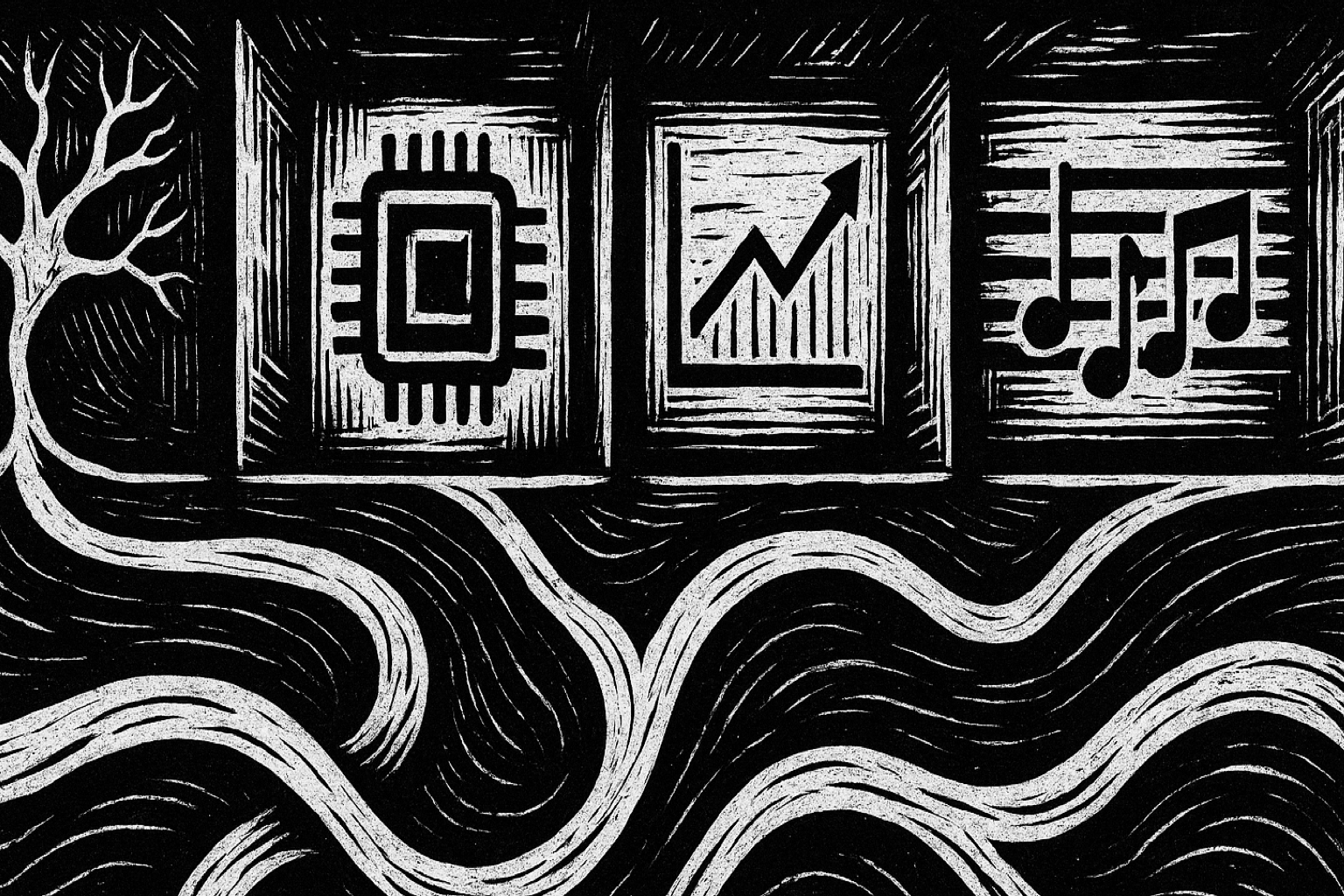
What if the most important part of learning was never named, because it lived beneath every subject instead of inside any one of them?
School presents knowledge as a set of separate rooms. Biology occupies one place, physics another. Chemistry stands apart, mathematics has its own corner, and computer science arrives later with a vocabulary that seems disconnected from everything before it. Literature, art, and music sit in a different wing entirely. The layout suggests that each discipline has its own logic, unrelated to the rest.
Yet underneath all of this moves something quieter. It shapes how systems behave, no matter their material. It guides how organisms sense and respond, how machines hold direction, how information moves, how decisions form, how tension builds and settles, and how creative work holds its arc.
This layer is not a subject on the schedule. It is the structure many subjects quietly rely on. A small set of recurring operations keeps showing up whenever something has to sense, decide, adapt, or coordinate.
Call it shared logic. Some systems convert one signal into another. Others maintain equilibrium against outside forces. Still others wait for a threshold before acting. These functional patterns appear across domains, even when described in very different terms.
Without awareness of this layer, biology feels alien to an artist, and software engineering feels disconnected from music. The walls between disciplines harden. Underneath, the same operations continue, untouched by those divisions.
You start to see it in pairings. A cell turning light into a nerve signal mirrors a microphone turning vibration into electricity. Thermoregulation in a body follows principles that resemble guidance systems in spacecraft. Neurons fire by threshold. So do transistors. Genetic information moves across generations in patterns that rhyme with the way data moves across networks.
The pattern shows up in the arts as well. Musical tension and release trace arcs familiar from adaptive systems. A dancer’s movement reflects constraints and tradeoffs an engineer would recognize. Ecosystem dynamics echo the push and pull of markets. Materials and goals differ, yet the same underlying moves keep surfacing. The same shared logic keeps showing through.
Take transduction. If you focus on light, you stay in optics. If you focus on sound, you stay in acoustics. If you focus on chemicals, you stay in physiology. When you focus on the act of signal conversion, you suddenly see something they share. Attention shifts from the topic to the move.
I wish someone had pointed this out when I was sitting in high school physics, wondering why it felt so far from music. No one said, “You are watching the same kinds of operations that shape the pieces you listen to.”
Modern AI picks up this shared logic by brute exposure. Trained across mixed domains, large models do not inherit the boundaries that school imposes. They learn physics beside poetry, software beside anatomy. They begin to detect the moves that recur: signal conversion, feedback, thresholds, constraint, coordination.
The model often registers the structure before it cares about the label. That is why some outputs feel strange when filtered through traditional categories. It is following a layer beneath the course list.
Imagine a system trained on climate records, port schedules, hospital data, and concert audio. It may notice that the way cargo backs up at a harbor in a storm resembles the way patients stack up during flu season, and that both look a bit like peak volume inside a stadium before a headliner walks on stage. Different actors, different stakes, but a similar pattern of demand rising faster than capacity and then slowly resolving. That is shared logic, not shared subject matter.
When humans start tracking that same layer, the interaction with AI changes. What once looks like a leap begins to feel like recognition. You can see when the model is noticing a familiar operation in an unfamiliar place.
AI accelerates discovery by surfacing where these operations repeat across very different systems and by doing comparison work at a scale that would drain a lifetime at human speed. It still does not decide what matters. Someone has to choose which patterns to trust, which ones mislead, and which ones serve real goals. Judgment, purpose, and responsibility sit outside the pattern matching itself.
People who learn to see the operations beneath the surface gain an edge. They notice what repeats. They feel the weight of the consequences. They choose, more deliberately, what to build.
For a learner, this changes the habit of mind. When you meet a new subject, you can start by asking simple questions: what is sensing? what is being transformed? what holds the system steady? what lets it change? These questions bring the shared logic into view, the layer most subjects forget to name.
Over time, disciplines stop feeling like sealed rooms. They begin to read like different passages written in the same language. The symbols change. The core moves remain. Once you learn to read those moves, you can carry understanding from one field into another and keep finding the same shared logic underneath.
When you study, are you memorizing surface details, or are you training yourself to read the shared logic that shapes reality?
What kind of mind do you want to build?
If you choose to study how systems behave, how feedback works, how thresholds trigger change, and how coordination emerges from parts, you are not only learning isolated subjects. You are learning to see the shared logic of complex things. A mind that reads that logic with ease can connect ideas that school never placed in the same room and can build work that rests on the shared logic beneath them all.