Uniquely Human Wisdom
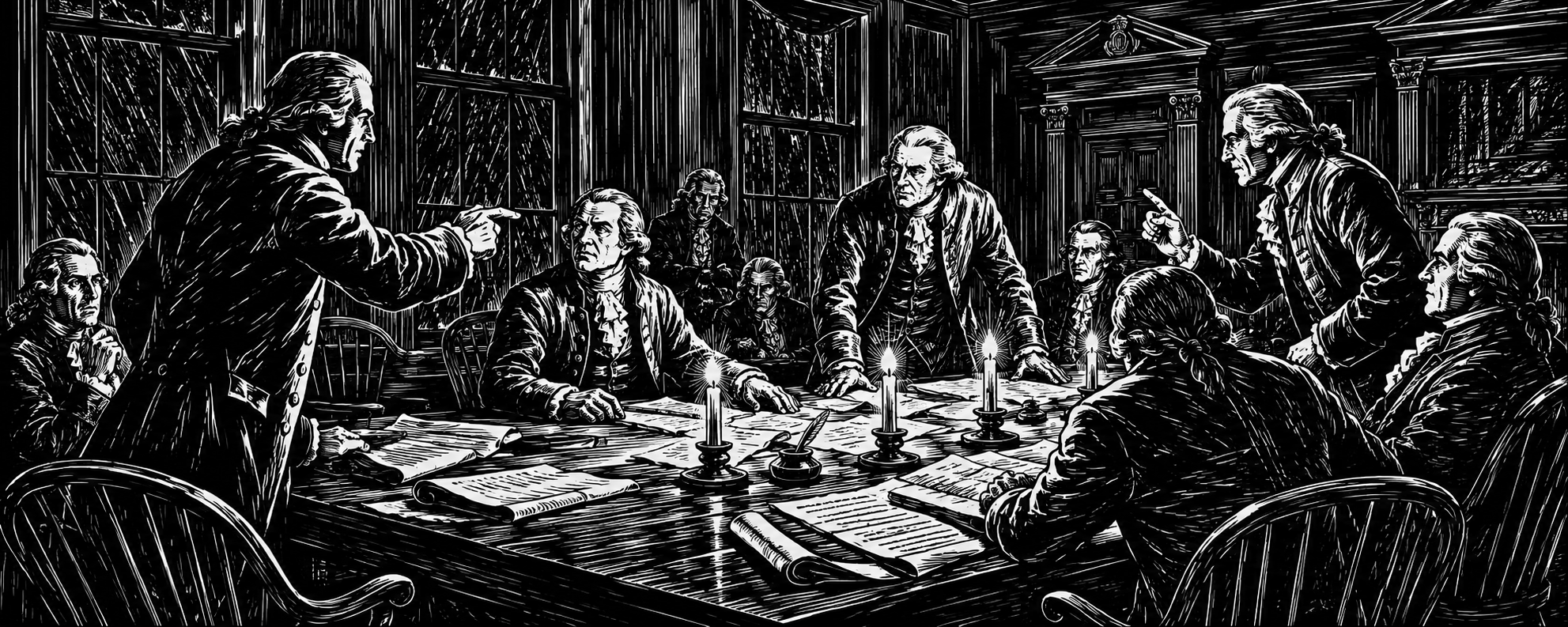
The rain had not stopped for three days, and Philadelphia smelled of wet wool, horse mud, candle smoke, and worry.
Inside the room, the men were tired of one another.
Madison sat with papers stacked before him, each page marked, revised, crossed, and argued back into life. Hamilton paced too quickly. Franklin watched the room with that dangerous softness of his, the kind that made younger men wonder whether he was amused, disappointed, or already ten years ahead of them.
They had intelligence. No one doubted that. The room was crowded with it, men who could read law in one language, philosophy in another, and human ambition in all of them. Men who could draft, argue, calculate, remember, and destroy a weak proposal before the ink dried.
But intelligence had only brought them to the table. It had not solved the problem.
Outside the windows, thirteen states waited with thirteen kinds of suspicion. Some feared a king. Some feared a mob. Some feared creditors. Some feared soldiers. The old arrangement was failing. The debts were real, the factions were real, and foreign powers were watching closely enough to smell weakness if the whole experiment began to crack.
Hamilton stopped pacing.
“We need energy,” he said. “A government that cannot act is only a sermon.”
A smaller-state delegate replied sharply, “And a government that can act too easily is a weapon.”
The room stirred. No one liked the answer because both men were right. That was the misery of it. Simple men could afford simple answers; these men could not. If they guessed wrong, farmers, merchants, and soldiers would pay for it. Their children would inherit the wreckage.
Madison wrote a line, then stopped.
“What if the trouble is not merely the shape of government,” he said, “but the shape of man?”
Franklin lifted his eyes.
Madison continued more quietly. “We keep speaking as if the right arrangement will draw virtue out of office. Perhaps it must also restrain ambition when virtue fails.”
There was silence, but it was not agreement yet. A chair scraped too hard against the floor. Someone near the window muttered something about theory being easier for men whose states had less to lose.
The large states pressed. The small states resisted. The commercial men worried over trade; the debtors worried over creditors. Each man saw part of the danger. No man saw all of it.
That friction was the very thing that saved them. A beautiful plan from one mind might have failed the first time it met another state’s fear. A plan drawn by one faction might have protected its own interests and called that order. The room would not allow purity. It interrupted every clean idea and forced every theory to drag its feet through mud.
By evening, the candles were low. The talk had slowed into something deeper than debate, moving from what a government should be to what human beings could actually be trusted to do with power once they held it.
Franklin leaned back, hands folded over his stomach.
“Gentlemen,” he said, “we have been arguing as if the danger lives only in the other man’s plan.”
No one rushed to answer.
The flaw was not confined to their opponents, to monarchs, or to mobs. It had entered the room with every man who walked through the door.
Madison looked down at his papers again.
A government for angels would be easy. A government for men required architecture.
Ambition would have to check ambition. Power would have to answer to power. No office could be trusted entirely because no man could be trusted entirely. And yet, the design could not be built on contempt. It had to leave room for honor, service, and greatness, while admitting that those things would not always arrive on schedule.
They were not merely trying to win an argument. They were trying to build something that could survive them. Something strong enough to govern, and restrained enough not to devour.
And beneath the arguments sat contradictions they could not solve, and some they would not face.
The rain finally eased near dawn.
No one in the room thought they had solved human nature. They had not made a perfect thing; they had made a thing that knew perfection would not come.
Elections would test it. Courts would test it. Wars, greed, courage, and cowardice would test it. Generations not yet born would live inside the consequences of sentences written by tired men in a hot room.
And somewhere near the bottom of the page, beneath all the brilliance, compromise, and hope, a deeper truth was becoming visible:
Intelligence had brought them into the room.
Wisdom was what the room required of them.
This historical fiction story was written with the help of AI.
It shows how intelligence becomes wisdom through pressure, consequence, plurality, reflection, humility, moral purpose, and time. AI can supply intelligence, but it cannot live the human conditions that turn theory into wisdom.