Frank Gets the Job. You Don't. Here’s Why.
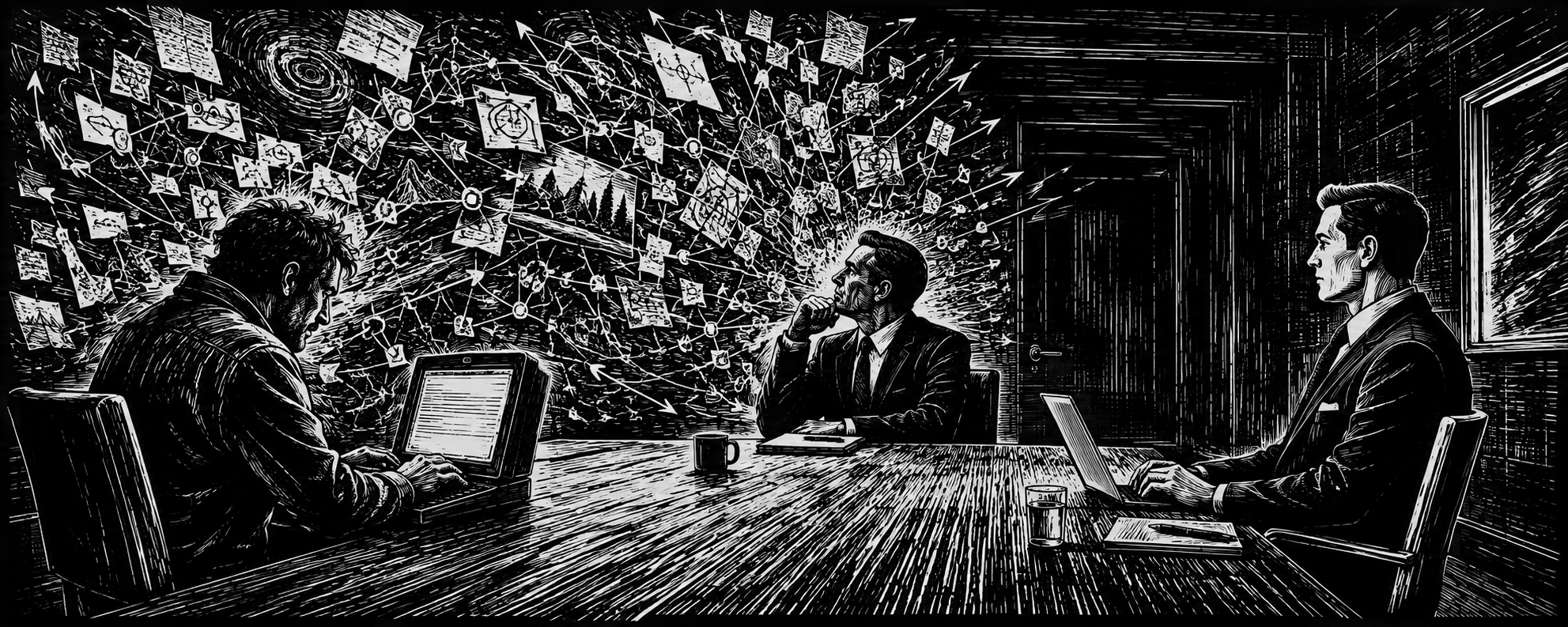
Frank did not look like the future of work.
He looked like a guy who still owned a laptop with a DVD drive.
It was thick, black, scratched, and made a small plastic complaint when he opened it. His jacket was fine, but not quite right. His shoes were practical in a way that suggested he had not spent much time thinking about shoes. He carried a notebook with a pen clipped to the cover, which gave the whole thing a faintly municipal feel.
The other finalist had the better laptop, better bag, better posture, and the kind of answer that makes people nod before they have learned anything.
For the first twenty minutes, the interview went about as expected.
Then the hiring manager tried something different.
She did not want access to anyone’s account. She did not want passwords. She did not want some giant export of private AI conversations sitting in a company folder forever. That would be creepy, and probably a legal mess.
Instead, she gave both candidates the same prompt and asked them to run it privately. They could use whatever AI history, memory, saved context, notes, or files they were comfortable using. They could read the answer before sharing it. They could remove anything personal, confidential, or irrelevant.
The prompt was simple:
Using your own AI history and any relevant saved context, produce a concise brief showing what you have explored, learned, built, questioned, improved, or changed your mind about that is relevant to this role. Exclude anything private, confidential, personal, medical, political, religious, or otherwise irrelevant. Focus only on job-relevant capability, and include examples you would be willing to discuss.
The polished candidate went first.
His answer was fine. He had used AI for research, writing, brainstorming, summarizing, and productivity. He mentioned a few tools. He said he was excited by AI’s potential. There was nothing wrong with it. If anything, it sounded like the answer most people would expect.
Then Frank shared his.
Frank’s brief had a different texture. It was not especially slick. Parts of it were probably too detailed. There were thread titles that sounded like work, not content. There were half-finished frameworks, abandoned angles, repeated attempts to understand the same constraint, and a few places where he had clearly misunderstood something and worked his way back through it.
That was the interesting part.
It did not feel like Frank was trying to prove he knew AI. It felt like the company had been handed a narrow window into work that had already been happening for a long time.
He had been inside the problem.
Not officially. Not because anyone gave him the job yet. But he had been using AI to think around the kinds of problems the company cared about. His context showed old questions, corrections, working language, rough models, and a pattern of returning to things that were not easy to settle.
A few examples were ordinary. A few were probably useless. But the body of work was not thin.
That matters.
Most people can say they are curious. Most people can say they learn quickly. Most people can say they use AI.
Frank had evidence.
Not perfect evidence. Not a credential. Not a substitute for doing the job. But enough evidence to make the interview move differently.
The company could now ask about a specific thread, a specific assumption, a specific change in thinking. They could ask why he abandoned one approach and kept another. They could ask where the AI was wrong. They could ask what any of this would make possible in the first month.
That is a much better conversation than asking someone to describe themselves as strategic.
This is the part I think people are missing.
A heavy AI user does not just get faster at isolated tasks. Over time, if the use is serious, something starts to accumulate. The person builds a private working library around problems, industries, arguments, customers, workflows, vocabulary, decisions, examples, and mistakes. Some of it is organized. Some of it is a mess. But it is there.
In a narrow domain, two or three years of that can become a real advantage.
It may matter even more when someone is trying to enter a field from the side. “I can learn” is easy to say and hard to evaluate. “Here is evidence that I have already been learning, and here is how I do it” is a different claim.
That does not mean Frank is automatically better than the other candidate. It does not mean the company should ignore experience, judgment, references, or actual work history. It means the interview has access to a new kind of signal.
The signal is not just what Frank knows.
It is how Frank moves through uncertainty.
Does he accept the first answer or press against it? Does he use AI to make weak thinking sound smoother, or does he use it to expose the weak spot long enough to fix it? Does he collect interesting fragments, or does he turn them into something that could actually be used?
You would not need to ask those questions as a personality test. You could ask them against the work.
Frank got the job because he brought more than interview answers into the room. He brought accumulated context, and the hiring manager found a clean way to see a small piece of it.
The other candidate had AI as a talking point.
Frank had something closer to an AI work history.
That advantage was not created in the interview. The interview just gave the company a way to notice it.