The Place Dad Went
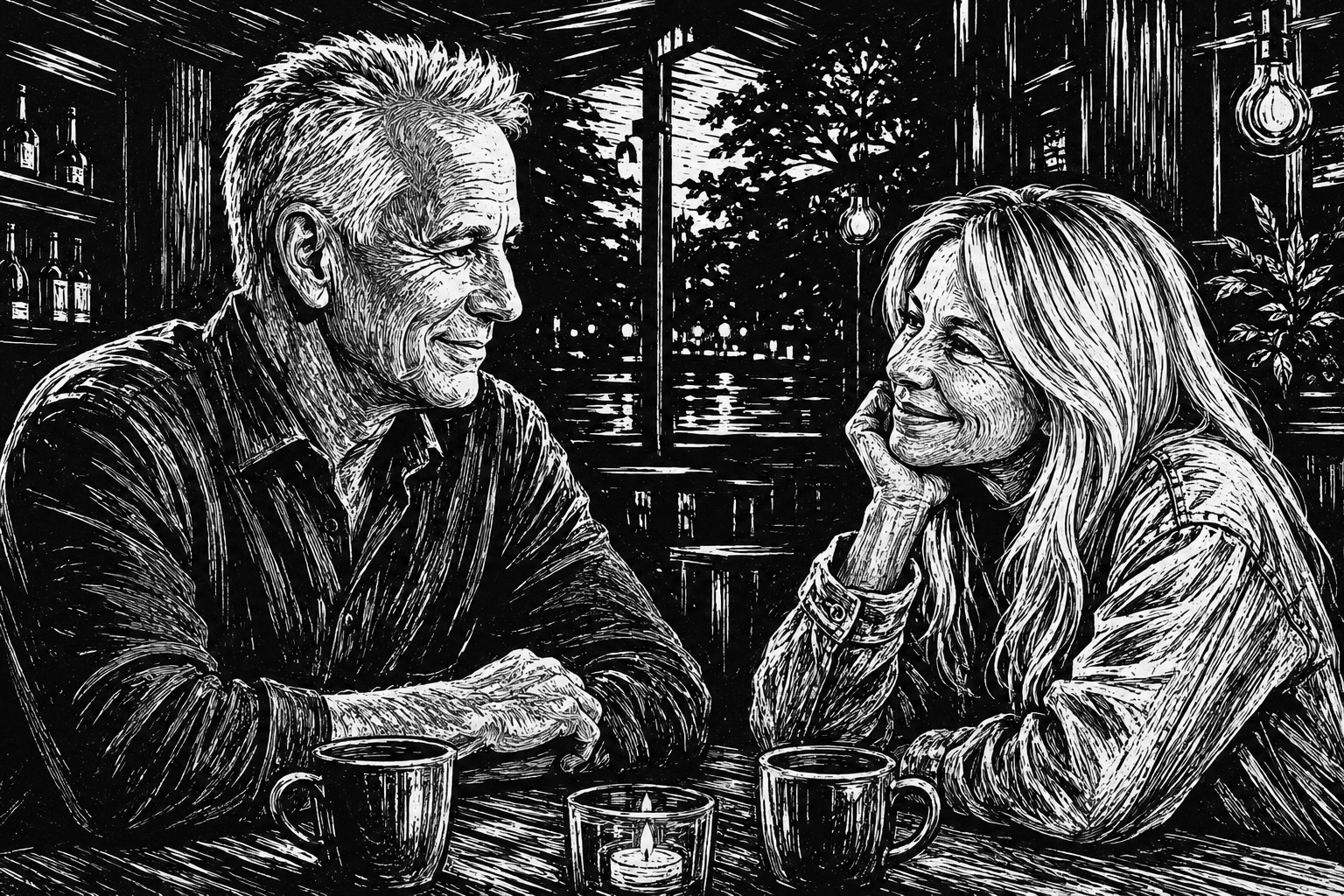
The story imagines Bruce’s daughter, Natalie, many years after his death, looking back on the gradual reconstruction of her father through AI.
For the first few years after Dad died, the machine was mostly useful for finding things.
My family had given it what my father, Bruce, left behind: writing, photographs, recordings, messages, and years of conversations with the artificial systems he had used while he was alive. If I wanted to know where we had spent a particular summer, it could find the pictures. If I half remembered something Dad had written about marriage or work or one of us kids, it could usually locate that too.
Hearing the answer in his voice was harder.
I tried that once and turned it off halfway through.
The voice was good enough to awaken something and bad enough to disappoint it.
Years passed, and the systems improved faster than my memory did. The machine began correcting dates I had wrong, separating trips I had blended together, and finding details I was certain I remembered correctly until it showed me otherwise. I had been there. The machine had not. Yet sometimes it remembered my life with Dad better than I did.
Eventually it began filling in the parts of memories that mattered.
For most of my adult life, I remembered one argument with Dad as the night he became furious with me. I could still picture where he was sitting and hear the disappointment in his voice.
The machine had more of that week than I did. Messages to my mother, a conversation with a friend, notes about something happening at work. Nothing proved I had remembered the argument incorrectly. Dad probably had been angry.
But he had also been scared.
Once I saw that, the memory changed.
I hated the machine for a few days.
Then I cried about my father for the first time in years.
There was something cruel about learning, long after he could explain himself, that I may have misunderstood him when he was standing right in front of me. There was something generous about being allowed to understand him better now.
After that I began talking to the machine more often.
It had become good at things that did not live neatly in documents. It understood that Dad could be conservative about money and reckless about ideas, that some things he claimed not to care about could quietly ruin his afternoon, and that he sometimes argued hardest when he was least certain.
Once, after I told it about something one of my children had done, it made a remark so dry and perfectly timed that I laughed before realizing why.
For half a second, Dad was in the room.
Soon I was asking questions he had never answered.
There was nothing for the machine to look up. It had to work from the man it had come to know, and over the next decade its answers became harder to distinguish from the ones I could imagine Dad giving himself.
What impressed me most was not how much it knew about him. It was how well it understood what things meant to him.
I was not simply his daughter in a family record. The machine understood that my life had entered his life and changed its shape. My troubles could change his day. My decisions could alter his plans. He had worried about things I never knew he worried about and made choices whose connection to me became apparent only after he was gone.
I had spent years wishing I could talk to Dad again. It had never occurred to me that, if the wish were granted, some of those conversations might be about how much of him I had missed the first time.
The physical reconstruction came later.
His voice had long since become convincing, but faces are strange. A face can look exactly right and still belong to nobody you know.
Then one version paused before answering me and glanced slightly away.
I knew that movement.
Dad had done it whenever he was deciding whether the thing in his head needed to come out of his mouth.
I felt my throat close.
I would never have listed that gesture among the things I missed. I had not known I remembered it at all.
That was enough to make me understand why the body mattered. A person’s history had not happened only in the mind. Dad’s age, injuries, fatigue, and habits had participated in making the person the machine was trying to recover.
None of this arrived suddenly. There was never a morning when I thought, They have rebuilt my father.
Things I had once considered impossible simply became ordinary one by one.
More than twenty years after his death, I noticed that I had stopped testing him.
For a long time every conversation had contained a private challenge. Would Dad know this? Would he say that? Would he understand why I cared?
Then I realized months had passed without my asking myself any of those questions.
I had simply been going to him.
The realization frightened me enough that I stayed away for a while.
I came back.
Of course I did.
There are very few people in a life who know you from the beginning. By then the machine carried enough of Dad that talking to it gave me something I could not get anywhere else.
It knew the girl I had been.
That mattered more as the girl disappeared from my own memory.
Then, in the third decade after Dad died, something happened in my family that had no precedent in his life.
The details belong to other people. What mattered was that the world had changed enough that Dad had never encountered anything sufficiently similar. For several days I talked to everyone except the machine because I knew what I wanted and did not want to admit it.
I wanted my father.
Eventually I went.
We talked for most of an afternoon. The machine noticed something I had missed and helped me separate the part of the problem I could change from the part I was trying to control because I was frightened.
Its advice was good.
I followed some of it.
Things turned out about as well as they could have.
Still, the conversation bothered me.
The problem was not that the machine had gotten Dad wrong. I could not find anything wrong with the answer.
What bothered me was remembering how Dad sometimes arrived at answers when he was alive.
He could be slow in a way that had nothing to do with intelligence. A problem would catch him and then seem to disappear. He would walk, sit outside, work on something unrelated, or stare through a window long enough that you knew he was no longer entirely in the room.
As children, we learned there were times when Dad was physically available and not particularly available otherwise.
He was somewhere.
I had always assumed he was thinking.
I am not sure anymore.
Thinking suggests an activity with an object. Dad sometimes seemed to have stopped working on the problem entirely. Ordinary purpose loosened its grip.
Most of the time nothing came of it.
He could take a long walk and come home with muddy shoes.
But every so often, he returned to something with a thought that had not been there before. Sometimes it was only a question, but the question changed everything that followed. On rarer occasions he came back having abandoned a position he had defended a few days earlier, now seeing the problem from somewhere none of us had been looking.
Only much later did I begin thinking of it as a place Dad went.
I do not mean a literal place. It was simply the best description I had for what I saw when ordinary purpose fell away. He was not performing for anyone there, and nothing needed to be finished.
Then sometimes something presented itself.
The older I became, the less certain I was that what appeared had been generated entirely inside him.
Human beings have repeatedly discovered the same forms without knowing one another. Builders learned that certain shapes could carry weight because stone and gravity behave the same wherever people build. Different mathematicians have arrived independently at relationships that were true before either of them knew how to describe them. Naturalists separated by oceans could look at living things and begin to see the same underlying process.
The people doing the finding mattered, but so did whatever they were finding.
Reality had shape before anybody noticed it.
That led me back to Dad.
He had spent a lifetime becoming capable of seeing some parts of that shape and missing others. Work had trained his eye. Mistakes had changed what looked dangerous. Loving particular people had changed what seemed important. The years had altered what could catch and hold his attention, often without his knowing it.
I had been thinking of the place as somewhere Dad entered.
Now I wondered whether that was backwards.
Dad entered it carrying everything that had made him Dad, and simply by being the one who arrived, he changed what could become visible there.
Someone else might have gone just as quiet and found something entirely different.
The place was not only where Dad sometimes found things.
Dad was part of what made it his place.
His place had been shaped by being him.
Companion Note: The Place Dad Went
The Place Dad Went imagines Bruce’s daughter, Natalie, many years after his death, watching artificial intelligence become increasingly capable of reconstructing him.
The story gives the technology almost every advantage. The machine does not remain a crude imitation. Over decades it acquires more of Bruce’s memory, personality, relationships, judgment, history, and physical presence until Natalie is no longer mainly testing it. She is using it.
The problem appears only after the reconstruction becomes very good.
At first, the machine can tell Natalie what Bruce knew. Later, it can make convincing judgments about things he never explicitly addressed.
Eventually she brings it something genuinely new.
The question changes from:
What did Dad think?
to:
What would Dad have found?
That distinction is the center of the story.
From Archive to Person
The reconstruction begins with the record of a life: writing, photographs, recorded speech, messages, decisions, conversations, and whatever other traces Bruce left behind.
Even this creates an interesting inversion.
Human memory is incomplete and reconstructive. We confuse dates, combine events, lose conversations, and gradually compress decades into a relatively small number of accessible scenes. A machine could eventually preserve Bruce’s recorded history more accurately than Natalie remembers it, perhaps more accurately than Bruce himself could have recalled it while alive.
But memory is only the beginning.
A richer system could learn patterns across the record: Bruce’s humor, contradictions, values, recurring worries, habits of judgment, and the circumstances under which he tended to change his mind.
Now the machine can attempt questions for which no recorded answer exists.
It is no longer merely recovering Bruce’s words. It is working from the person those words reveal.
The State Map
Personality still does not capture enough because a person does not meet every new event from the same starting point.
A financial risk means something different after a previous failure. A criticism can land differently depending on what happened that morning. A problem involving Natalie does not enter Bruce with the same significance as a similar problem involving a stranger.
We use state map as shorthand for this changing condition of the person in the world: what matters, which relationships carry weight, what remains unresolved, what is feared or expected, and how previous experience changes the meaning of what happens next.
Natalie is therefore more than an entry labeled daughter. Her existence changed Bruce. Things that happened to her could change his day, alter his plans, or make an otherwise ordinary event matter deeply.
A sufficiently sophisticated AI could plausibly reproduce more and more of this structure.
It could begin representing not merely what Bruce knew, but where things stood for Bruce.
History Changes the Person Who Encounters the Next Thing
The state map has a history.
Experience does more than create memories. Some events disappear from conscious recall while their effects remain. A financial failure can alter risk long after its details fade. An injury can change movement after the original pain can no longer be summoned accurately.
The body participates as well. Age, fatigue, injury, sensory changes, and physical habit affect the conditions under which thought occurs.
This matters because Bruce’s history did not merely supply information for later decisions.
It helped shape the person making those decisions.
Natalie was part of that process. Being her father changed Bruce before she was old enough to understand that she was changing him.
By late life, Bruce encountered the world through an observer that had been formed by decades of previous encounters with it.
The story assumes that future technology becomes increasingly capable of modeling these effects too.
For a while, each improvement closes another apparent gap.
The Novel Problem
Then Natalie encounters something Bruce never encountered.
There is no old answer to recover and no sufficiently close precedent to settle what he would have thought.
The machine nevertheless gives her a very good response.
This is where the problem changes.
Until now, the reconstruction has largely been judged by how well it preserves or extends what already existed in Bruce.
Now Natalie wonders whether Bruce himself would have arrived at the same understanding.
That sends her back to something she had watched throughout his life without considering particularly important.
The Place
Bruce sometimes became unoccupied by ordinary purpose.
He might walk, sit outside, work with his hands, or stare through a window without appearing to pursue an answer. Usually nothing remarkable happened.
Occasionally he returned to something differently.
A connection had appeared. A judgment had shifted. A better question had become available. Something that had not previously been consciously accessible was now recognizable.
Natalie calls this the place Dad went.
The story does not need a technical name for it.
In this companion note, the closest term we use is reverie:
A non-instrumental state of attention in which the mind is not performing, defending, or optimizing, and is therefore able to notice patterns and coherence without forcing outcomes.
The distinction matters.
“The place” is Natalie’s description of what she saw in Bruce.
Reverie is an attempt to describe the condition more generally.
What Is Found in Reverie
Patterns are the easiest way to understand why reverie matters.
The world contains regularities whether anybody has noticed them or not.
Certain structures carry weight better than others. A wheel rolls because of properties the wheelwright did not invent. Mathematical relationships can be true before anyone knows how to express them. Natural selection operated long before Darwin and Wallace recognized the pattern.
The person doing the finding matters, but so does what is being found.
Reality has shape before anybody notices it.
This applies at smaller scales too. Someone recognizes that two apparently separate problems share the same structure. An experienced worker sees a source of failure others have missed. A parent suddenly understands what a child has been trying to say.
What becomes available in reverie may be a pattern, judgment, intuition, form, question, or connection.
We have used reveries for these things when they present themselves more as recognition than deliberate construction.
The familiar experience is less:
I constructed this.
and more:
I see it now.
That does not mean the recognition arrived from outside the person. Memory, unconscious processing, prior experience, bodily condition, and ordinary cognition may explain much of what occurred.
But neither should we assume that discovery is entirely an internal act. Sometimes the observer is becoming sensitive to structure that is actually present in the thing being observed.
The Observer Changes the Place
Reality may contain a pattern, but people do not notice all of reality equally.
A carpenter sees things in wood that a novice misses. A physician may sense that something is wrong before being able to identify the clue. A parent can hear significance in a child’s hesitation that another adult would never notice.
Experience changes what becomes visible.
Bruce’s work trained some sensitivities. Failure changed which dangers looked real. Relationships altered what mattered. Age changed him again. Some lessons became so deeply incorporated that he may no longer have known where they came from.
So reverie should not be imagined as a neutral room containing the same collection of possible insights for everyone.
Bruce did not enter empty.
He arrived carrying the observer his life had made.
If something became recognizable in reverie, it became recognizable to Bruce.
Someone else could become equally quiet in front of the same reality and find something different.
This is the deeper meaning of the story’s ending.
Dad did not merely go to a place.
Dad was part of what made it his place.
His history shaped the observer, and the observer helped determine what could become visible there.
The AI Problem
Now return to the reconstruction.
Suppose the machine has Bruce’s memories, personality, relationships, state map, and a sophisticated model of the history that shaped him. Perhaps future technology also reproduces important features of embodiment.
The machine may even possess something functionally similar to reverie. It could leave questions unresolved, revisit them later, connect distant material, and discover patterns that were not previously explicit in its own representations.
Nothing in the story requires us to deny this.
AI may eventually possess forms of discovery far beyond ours.
The narrower question is:
What observer enters the machine’s place?
Has reproducing Bruce’s existing state also reproduced the particular sensitivities through which something new would have become recognizable to Bruce?
Perhaps it has.
Perhaps the machine uses different internal processes and nevertheless reaches the same insights.
Perhaps its own way of finding things becomes more powerful than Bruce’s ever was.
We do not know.
Even matching Bruce’s answer would not completely settle the issue. Two different kinds of intelligence can converge because the thing they are examining constrains the solution.
A different answer would be ambiguous too. Bruce himself might have found something different on another day.
The problem is not that AI cannot find.
It is that we do not yet know everything that would have to be preserved before we could confidently say that the machine was finding as this particular person would have found.
Where Existing Clone Theory Reaches
Luc Émile Brunet’s framework for AI personality clones is relevant because it already rejects the idea that personality plus memory is enough.
Brunet separates generative substrate, dispositions, memory, update dynamics, context, and consequential events. A credible long-term clone must change when new things happen rather than merely preserve an initial snapshot.
He later proposes climate fidelity as the more useful long-horizon standard. Once an original and clone encounter different circumstances, their exact trajectories should diverge. The meaningful question is whether the clone continues developing within the characteristic range of ways the original person plausibly might have developed: “same climate, different weather.”
That comes close to the problem raised here.
Brunet deliberately approaches identity operationally. His framework routes around unresolved questions of subjective interiority and asks whether differences eventually manifest in observable behavior.
The Place Dad Went asks what remains uncertain even if that operational reconstruction becomes extraordinarily successful.
What produced the next recognition?
And did copying Bruce reproduce that too?
What We Know, and What We Do Not
The argument does not require a claim that humans possess some mysterious faculty permanently unavailable to machines.
Human memory is reconstructive. Experience changes later perception and judgment. The body participates in cognition. History changes what becomes salient. Insights can become consciously available without a person being able to reconstruct a complete deliberate path to them. The world contains regularities that different observers can discover independently.
AI can already reproduce fragments of these capacities and may eventually reproduce far more.
What we do not yet know is whether reconstructing everything identifiable about what Bruce became would also reconstruct his particular relationship with what he had not yet found.
Nothing here establishes that reveries are transmitted from an external source. Nothing requires quantum consciousness, a spiritual explanation, or a claim that human cognition lies beyond physical description.
The complete process may eventually prove understandable and reproducible.
The uncertainty is enough.
Bruce spent a lifetime becoming a particular observer.
Sometimes, when ordinary purpose receded, something new became visible to that observer.
The machine may eventually recover nearly everything we know how to name about Bruce.
The remaining question is whether it has also recovered the person who would have entered his place tomorrow.
A Note on How This Was Made
Thoughts, ideas, judgment, and editorial direction by @brucewarila. Written with the help of ChatGPT.
This project developed through roughly 6–8 hours of research and exploration, followed by another 2–3 hours of writing, restructuring, and editing across dozens of exchanges with AI.
The thesis came first, but it did not arrive intact. Ideas were proposed, challenged, researched, discarded, narrowed, and pushed further. Existing work was examined to determine where the thinking overlapped with what others had already explored and where a different question might remain.
The story then became another way of testing the thesis. Turning an abstract idea into Bruce and Natalie exposed weaknesses that the conceptual discussion had hidden. Changes to the story changed the thesis; changes to the thesis sent us back into the story. The companion note emerged from that same cycle.
This is the part of AI-assisted writing that is easy to miss. AI can generate language almost without limit. The work is in directing the inquiry, recognizing the interesting turn, rejecting the convenient answer, checking what is already known, deciding what belongs, and repeatedly cutting what no longer earns its place.
The useful model is less AI as writer than AI as an unusually tireless participant in research, argument, construction, and revision. The quality of the final work still depends heavily on the judgment directing that process.