What Red Brick Can Teach AI
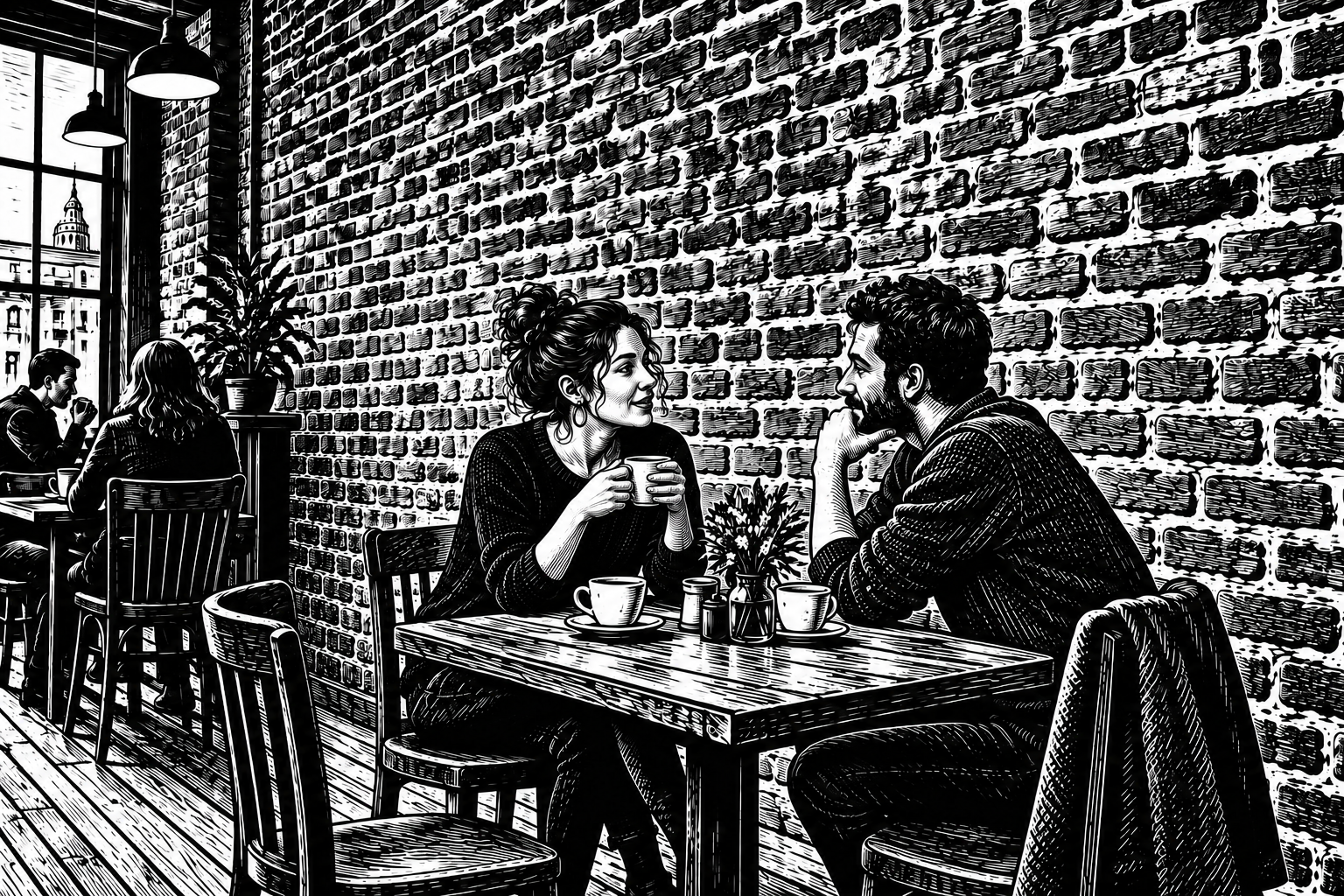
Two people walk into a coffee shop looking for a place to sit. There are empty tables throughout the room, but they choose one along the exposed red brick wall.
The bricks wander through reds, browns, oranges, an occasional near-purple. Mortar catches the light differently from clay. Some units sit slightly proud of others; some have softened at their edges. The wall has depth without demanding attention. You can see how it was made even if you never think to ask.
The people at the table do not ask. They simply like sitting there.
We make this choice often enough that old brick has become an asset. Restaurants expose it. Developers preserve it. New buildings sometimes imitate it. We seem to recognize something in these walls before we have language for what it is.
That makes the brick an interesting object to carry into the age of AI and robotics.
A traditional brick is roughly the size it is because somebody once had to pick it up. Then pick up another, and another, thousands of times. Its dimensions emerged inside a system that included the human hand, the trowel, mortar, gravity, transport, structural bonding, and the length of a working day. Bricks had to be graspable and repetitive, but also able to turn corners, overlap joints, span openings, and combine into walls much larger than themselves.
From those constraints came something remarkably durable. Boston is full of masonry buildings that have been occupied, altered, repaired, repointed, and occupied again for more than a century.
We largely stopped building them that way for a mundane reason: human labor became expensive.
Modern construction learned to do more with fewer touches. Structural frames carried larger loads. Wall assemblies separated structure, insulation, drainage, air control, and finish. Components grew larger and installation accelerated. Brick often remained, but increasingly as a veneer rather than the substance of the wall.
Now the economic assumption underneath that transition is beginning to move.
A robot does not care that placing the ten-thousandth brick is repetitive. Computer vision can inspect placement. AI can reconcile the model with what is actually happening in the field. Machines can stage material, adjust sequences, identify errors, and perform physical work whose economics once depended overwhelmingly on human time.
Using robots to recreate the walls of 1890 would miss much of the opportunity. Once the machine is doing the lifting, there is no particular reason for a masonry unit to fit a human hand. It can weigh fifty pounds or a hundred. Its shape can change from one placement to the next. A wall can thicken where it needs mass, open where it needs light, create shade through its geometry, integrate structure and enclosure differently, and contain variation that would have been prohibitively expensive when every departure demanded additional human effort.
That is where things get interesting, and also where the risk begins.
If we ask the machine to build the wall faster, larger units quickly become attractive. Fewer placements, fewer joints, less mortar, more speed. Follow that logic far enough and the brick wall in the coffee shop disappears.
Perhaps the new wall performs better thermally and costs less to construct. Yet something has changed that was never included in the assignment.
The little brick was doing more than filling space. Its size gave a large surface a scale the eye could understand. Mortar created rhythm and shadow. Differences in firing produced ordered variation. Small units moved naturally around corners and openings and localized damage when something failed. The wall revealed its assembly rather than hiding it, and repair could happen in pieces.
Somehow these effects accumulated into a place where two people wanted to sit.
No mason centuries ago sat down and specified all of those outcomes. Some were deliberate. Others emerged because clay, mortar, hands, tools, economics, and time happened to interact in a particular way.
This is where the brick stops being only a construction story.
AI is extraordinarily good at pursuing a job once we define it. The harder problem is discovering the jobs we failed to define.
A wall encloses a room, but it also affects repair, aging, acoustics, weather, perception, identity, and behavior. A street moves traffic while shaping commerce, encounters, noise, safety, and the pace at which a place is experienced. A chair supports a body and can also signal whether someone is expected to stay for ten minutes or two hours. An old object may look inefficient until we notice that it was built to be repaired rather than replaced.
Our mistake is often to identify the most visible function and treat everything else as incidental.
AI and robotics make that mistake more consequential because they can remove constraints that once performed design work without anyone noticing. The limits of the hand helped shape the brick. The brick helped shape the wall. The wall influenced openings, buildings, and streets. An entire visual language accumulated downstream of a physical limitation that nobody would deliberately recreate if efficiency were the only goal.
Some old constraints are burdens worth removing. Others produced secondary qualities whose value became visible only after we started taking them away. That makes discovery more important before optimization begins. What else is this thing doing? How does it fail? How does it age? What can be repaired locally? What behaviors has it encouraged? Which qualities are intentional, and which emerged from limitations we are now capable of eliminating?
These questions matter more as AI moves from software into the physical world. Buildings, streets, tools, furniture, and machines persist. Changes to them can outlast the assumptions that produced them.
The masonry wall of the future may contain units no mason could lift, geometries no mason would economically lay, and forms of structural intelligence impossible in traditional brickwork. It may also preserve human scale, repairability, variation, depth, and the quiet visual richness that drew someone toward the old wall in the first place. Getting there requires more than identifying the primary function and optimizing it.
Brick is a useful stand-in for a much larger category of things shaped by human limits. AI and robotics are beginning to remove many of those limits, often for very good reasons. The difficult part is that we may never know all the things those limits were quietly contributing before they disappear.
The people in the coffee shop cannot give us a requirements document explaining why they chose that table. Some part of the answer lives in color, scale, shadow, age, texture, memory, familiarity, imperfection, and relationships among those things that may be difficult to isolate at all.
We are getting very good at optimizing what we can name. The brick is a reminder to be careful with everything we cannot.
Thoughts, ideas, judgment, and editorial direction by @brucewarila. Written with the help of ChatGPT.