AI May Make Us More Human
A lot of the anxiety around AI comes down to a simple fear: if machines can do more of our thinking, writing, making, and problem-solving, we will eventually become less capable ourselves.
That future is possible. AI can make it easy to stop thinking too soon. It can create the appearance of competence without the substance. It can produce work we barely understand and save us from struggles we probably should have had.
But I think the larger story may run in the other direction.
AI may enable far more people to become productive creators.
We tend to assume that people who make consequential things possess some kind of secret key. They are unusually talented or driven. They know the right people. They have technical skills, money, confidence, education, or some rare ability to move from an idea to something real.
There is truth in that. But I suspect many people already possess most of the key.
They understand a problem because they have lived with it. They see something that could be better. They have experience, judgment, curiosity, and enough imagination to picture a different outcome.
Then they run into one thing they cannot do.
Maybe they cannot code. Maybe the idea crosses into a field they know nothing about. They need a prototype and have no idea how to make one. They cannot explain the idea well enough to get help. Sometimes they simply reach a point where they do not know what comes next.
That can be enough to end the whole thing.
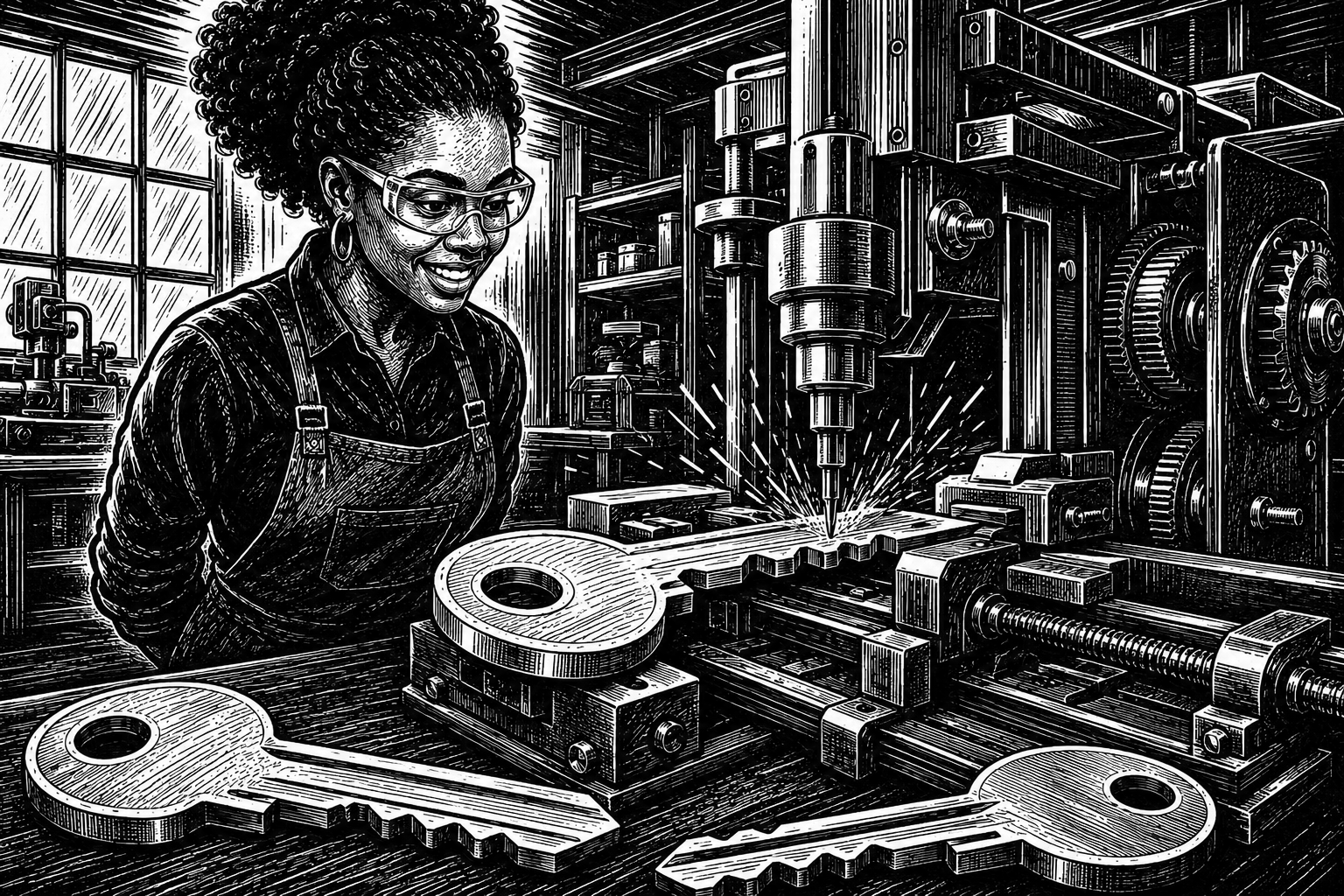
A nearly complete key opens nothing.
This is easy to miss because we only see the result. The book was never written. The tool was never built. The better process stayed inside the head of the person who understood the problem. From the outside, nothing happened, so it is tempting to conclude that there was never much there.
Perhaps the key was only missing a notch.
For most of history, cutting that notch could be expensive. It might require months of learning, access to an expert, a substantial amount of money, or the persistence to wander through an unfamiliar subject until something finally made sense.
AI changes that.
It can help someone enter a field without first mastering its vocabulary. It can turn a rough idea into a first version that is good enough to inspect. It can help identify the question that actually needs answering or make a failed attempt intelligible enough to try again.
That may sound modest compared with all the talk about artificial general intelligence. I think it is enormous.
AI does not have to make a person an expert. Sometimes it only has to get that person past the point where the project would otherwise have died.
Once that happens, reality takes over.
The prototype fails. Nobody wants the product. The evidence contradicts the theory. The writing is flat. The elegant plan becomes awkward when other people have to use it.
This is useful. The person now has something real to respond to.
That distinction matters because arguments against AI sometimes treat difficulty itself as a human good. Some difficulty certainly is. Failure can develop judgment. Revision can develop taste. Responsibility changes the way we think. There are forms of struggle that make a person more capable.
Other obstacles accomplish very little beyond keeping someone from entering the arena.
I do not see much human value in spending weeks deciphering an unfamiliar field before you can ask a sensible question, or abandoning an idea because one technical capability sits outside your education.
AI can remove some of that blocking friction without removing the harder and more valuable encounter with reality that follows.
This is why I think the usual discussion about AI and productivity is too narrow.
The interesting question is not only how much more work one person can produce. It is how many more people can become capable of acting on something they see.
That gets closer to agency.
There is something deeply human about noticing a possibility and then having some hand in making it real. The result does not have to be a company, an invention, or a work of art. It might be a better way of doing your job, a repaired machine, a useful piece of software, a neighborhood project, or something that matters only to a handful of people.
The scale is secondary. What matters is the experience of being able to affect reality rather than merely receive it.
That seems to me an important part of human flourishing.
A good life contains much more than creation. Love, friendship, faith, care, rest, play, and contemplation do not need to earn their place through productivity. Human worth has nothing to do with output.
Still, I would not want to define flourishing as a life in which everything good is simply delivered to us.
We are already very good at delivery. Food, entertainment, information, convenience, recommendations, answers. AI will make that machinery astonishingly better.
Agency is different. No one can deliver the experience of having mattered to an outcome.
You have to participate.
That is why I wonder whether one of the most common fears about AI has the story backward.
We spend a great deal of time asking what happens when machines can do things humans used to do. We should also ask what happens when ordinary people can suddenly do things that were previously beyond them.
History cannot tell us how much human capacity disappeared at those boundaries. We can count what was made. We cannot count what stopped one requirement short.
For most of history, blocked capacity looked exactly like absent capacity.
AI may finally allow us to see the difference.
It can certainly make people more passive. That danger is real.
But it can also help far more people get through the door and discover what happens when an idea finally meets the world.
That possibility feels much more human to me.
Thoughts, ideas, judgment, and editorial direction by Bruce Warila. Written with the help of ChatGPT.