A Life in Proportion
The golden ratio and a more durable way to change
For more than two thousand years, people have been fascinated by an unusual proportion.
Its mathematics can sound complicated. Its secret is easier to see.
Imagine a rectangle that is 100 inches long and 61.8 inches high. Cut a 61.8-inch square from one end. The rectangle left behind measures 61.8 inches by 38.2 inches.
Turn that smaller rectangle sideways. It has exactly the same shape as the one you started with.
Cut another square from it, and the same thing happens again. Each time you remove the largest possible square, a smaller version of the original rectangle remains.
That is the golden ratio.
It is built into mathematics and the Fibonacci sequence. Closely related patterns appear in sunflower seed heads, pinecones, and the arrangement of leaves. Artists, architects, photographers, typographers, and interface designers have used it to organize space and proportion. Some of the grander claims made about it are probably legend, but the ratio itself has remained compelling for centuries.
It divides a whole into roughly 61.8 percent and 38.2 percent. One part is clearly larger, but the smaller part is still substantial. More remarkably, the relationship survives as the shape gets smaller.
Now apply that proportion to the 365 days of a year.
The larger share is approximately 226 days.
The smaller share is approximately 139 days.
What if that proportion could offer a better way to think about change?
The container may be the problem
Most self-improvement systems judge us one day at a time.
Close the rings. Hit the step count. Follow the diet. Complete the routine. Protect the streak.
Measurement feels useful at first. It creates order, gives us evidence of progress, and makes improvement seem manageable. Then the year becomes less cooperative.
You get sick. Work takes over. Winter arrives. Your knee hurts. Someone needs you. You travel, sleep badly, or simply lose interest for a while. A practice that may have been helping you is suddenly recorded as a failure because a sequence of perfect days has ended.
The problem may not be discipline. The container may simply be too small.
A single day tells us very little about the direction of a life. Even a difficult week can be absorbed inside a year that is otherwise moving steadily toward something worthwhile.
If you make meaningful contact with a desired condition on 226 days, that condition has governed the larger share of your year. The remaining 139 days have not erased it. They have made room for illness, recovery, responsibility, distraction, bad weather, and the unevenness of an ordinary life.
You did not have to win every day.
The right condition only had to win the year.
Choose a condition
Begin by choosing one condition you would like to make more true over the coming year.
Stronger. Healthier. Wiser. Calmer.
The word should describe how you want to be, rather than prescribe the same action every day.
“Walk every morning” is an instruction. “Become stronger” is a direction.
“Read for thirty minutes” is an instruction. “Become wiser” is a direction.
“Never lose my temper” is a rule. “Become calmer” leaves room to learn what calm actually requires.
A condition can be reached through more than one activity. That flexibility is what allows the practice to survive real life.
A stronger day might include lifting weights, hiking, carrying materials, clearing brush, walking several miles, doing mobility work, or completing rehabilitation that keeps strength available. The day can build strength or help you retain it. Both count.
A wiser day might include reading, writing through an idea, studying a problem, asking a better question, changing your mind, or admitting that you were wrong.
A calmer day might include prayer or meditation. It might also be the day you listened before reacting, went outside rather than escalating an argument, or passed through a difficult situation without making it worse.
The activity can change. The direction stays the same.
This is the difference between rigid habit tracking and meaningful contact. You do not have to repeat one ritual perfectly. You have to return to the same condition often enough that it becomes a recognizable part of your life.
One workout will not make you strong. One serious book will not make you wise. One calm response will not change your temperament.
Repeated contact can.
The same principle applies to relationships. One unhurried conversation may not change a marriage, a friendship, or a family. Meaningfully connecting on 226 days almost certainly changes the atmosphere between people.
Small actions look different when viewed across a year.
The marble method
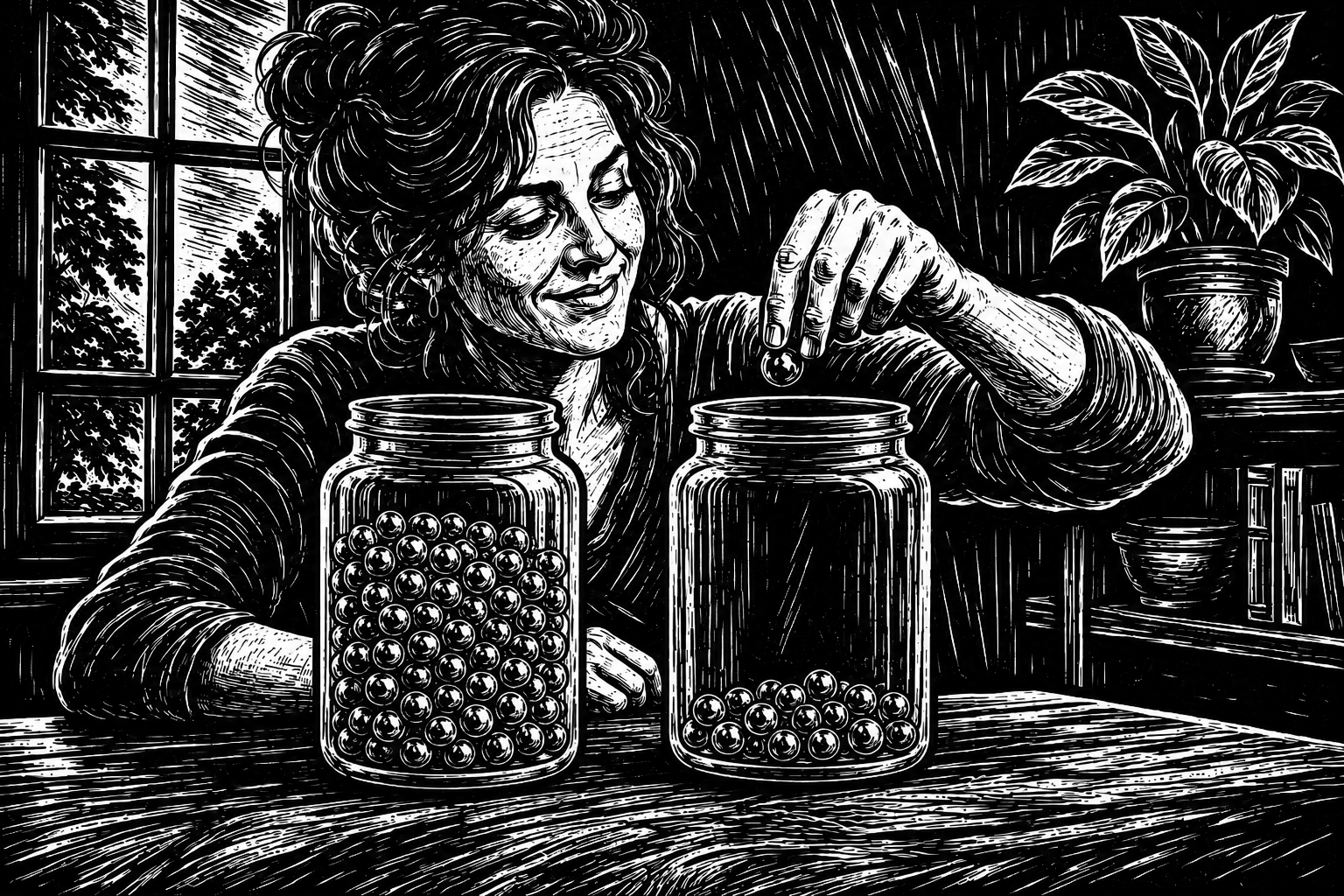
The idea can be practiced with two glass jars and 365 marbles.
Place all 365 marbles in the first jar.
Place an empty jar beside it and write your chosen condition on the front:
STRONGER
HEALTHIER
WISER
CALMER
Then decide, in plain language, what meaningful contact with that condition looks like.
Whenever a day qualifies, move one marble into the second jar. When it does not, leave the marbles alone.
Your goal is to move 226 marbles before the year ends.
That is the entire method.
One day can earn only one marble. A heroic Saturday does not earn three, and a modest but legitimate effort still counts. The system is meant to measure contact, not intensity.
There is also no need to record a failure when a marble does not move. Perhaps you were sick. Perhaps someone needed you. Perhaps rest was the wiser choice. Perhaps you wasted the day.
The jars do not need to settle that argument.
They only need to reveal which condition governed the year.
The first jar will not be empty in December. Some marbles will represent recovery, travel, grief, winter, family responsibility, or difficult seasons. Others will represent avoidance, distraction, or choices you would not make again.
They all belong to the same real year.
Only the marbles that move need to be counted.
A bad day is one marble that stayed behind. A bad week is seven. Neither one decides the year.
The larger share
The golden ratio is not a proven law of personal transformation. There is no guarantee that precisely 226 qualifying days will make every ambition come true.
Its value lies in the proportion it gives the year.
One state dominates. The other remains large enough to accommodate recovery, interruption, seasonality, and everything else that prevents life from becoming a controlled experiment.
The smaller share is not meaningless. It makes the larger share sustainable. But it cannot become the governing condition.
If you want to become stronger, strength needs the larger share.
If you want to become wiser, learning and reflection need the larger share.
If you want to become calmer, calm responses need the larger share.
The life you want does not need every day. It needs enough days to become unmistakably present.
At first, one marble dropping into an empty jar will seem insignificant. Over time, the bottom will disappear. The jar will grow heavier, and the condition you chose will begin to acquire visible weight.
By the end of the year, you will not need an app or a graph to tell you whether it became part of your life.
You will be able to hold the evidence in your hands.
Choose one condition worth becoming.
Define meaningful contact.
Move 226 marbles.
Let the larger share of the year change you.
If you enjoyed this post, you might also like The Load Bearing Life.