The Council for Unmediated Natural Tone
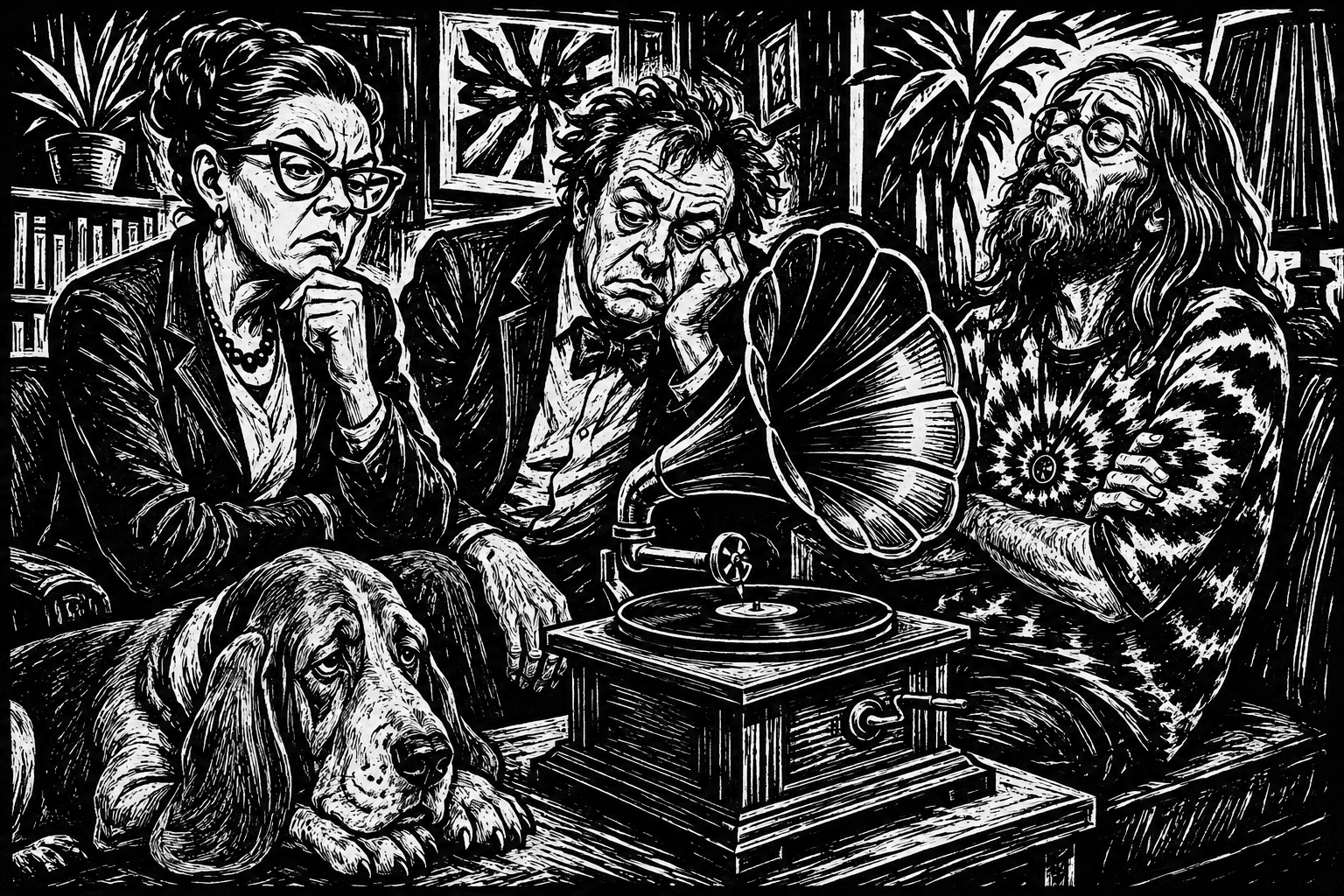
At first, music is voice, hands, and feet. Someone chants. Someone claps. Someone stomps. Then someone picks up two rocks and adds a beat.
The Council for Unmediated Natural Tone objects immediately. The chant already had hands and feet. Now everyone is supposed to trust a rock.
People figure out repetition. A phrase comes back around. The group remembers it. One voice starts. Other voices answer. Music becomes a group activity.
The Council objects. If everyone knows what comes next, maybe the song is carrying too much of the memory.
People start using whatever is nearby. Sticks, skins, shells, reeds, strings, hollow logs. If it makes noise, someone tries to play it. After a while, they stop waiting to find useful objects and start making instruments on purpose.
The Council is uneasy. A drum is already a problem. A carved reed is worse. At this rate, someone in the village is going to own all the noisy things and call himself necessary.
Then comes tuning. Musicians decide the notes should match. Instruments start to agree with each other. Music becomes easier to teach, repeat, and play with people from somewhere else.
The Council objects. Every village had its own way of singing. Now someone wants the hill people and the river people to hit the same note. This feels like the beginning of paperwork.
Then somebody writes music down. A song can leave the room. It can outlive the singer. It can be played by someone the composer never met.
The Council is not pleased. Marks on a page are not music. They are what happens when memory stops doing its job.
Music keeps splitting into jobs. One person writes. Another person performs. Someone teaches. Someone conducts. A single piece of music can involve dozens of people, many of whom did not write it.
The Council objects. If one person writes the tune and another person plays it, somebody is getting too much credit and somebody is getting too little.
Machines arrive. Mechanical instruments can repeat music. The metronome clicks at musicians like a tiny wooden judge. The piano lets one person play bass notes, chords, rhythm, and melody at the same time.
The Council objects. Time should be felt, not tapped out by a little box with an attitude. And no living room instrument should be allowed to sound that much like a band.
Recording changes everything. Music does not have to vanish after the last note. The phonograph captures it. The microphone changes how people sing. The studio lets people record takes, keep the best ones, edit parts, and build a song piece by piece.
By now, the Council has officers, minutes, and a rented room above a violin shop.
The Council objects. A proper song should happen live, contain a few wrong notes, and survive only as memory before anyone can compare it to the second take.
Radio makes things worse. Music no longer has to be performed nearby or brought home by someone who owns an instrument. A voice from somewhere else enters the kitchen, the shop, the bedroom, and the car.
The Council objects. Music should not simply come out of the furniture. At minimum, someone in the house should have to practice badly for several years.
Electricity gets involved. The guitar gets louder. Distortion becomes a sound people actually want. Electronic instruments begin making noises no tree, string, throat, or goat ever made.
The Council objects. This is not tone. This is electricity pretending to be music. Worse, the young people seem pleased.
The studio gets more flexible. Multitrack recording lets one person build a band one part at a time. Tape editing lets people cut up a performance and rebuild it. Drum machines make beats without drummers. Sampling turns old recordings into new songs.
The Council has a full agenda now. One person cannot be a whole band. A performance should not be repaired after it happens. A beat needs a drummer sitting there looking annoyed. Borrowing from the past should be reserved for respectable composers, folk singers, and people whose borrowing has already been placed in a museum.
Then the computer arrives. MIDI lets a note exist as information before it becomes sound. Digital audio workstations put the studio inside a laptop. Pitch correction makes the voice editable. Loops and sample packs give writers starting points they did not personally play.
The Council objects. Music now looks like homework on a screen. Also, almost anyone being able to make it is clearly too many people.
Releasing a song stops requiring a whole industry. A kid in a bedroom can write, record, mix, master, publish, and promote a song without a label, factory, truck, store, radio programmer, or man in sunglasses saying, “I don’t hear the single.”
The Council objects. Where is the truck? A serious song needs a truck, a warehouse, a regional sales plan, and at least one person named Gary who knows which stores are difficult.
And now we have AI.
AI can suggest chords, generate beats, clean noise, separate stems, write lyrics, imitate instruments, create harmonies, and offer ten versions of an idea in a few minutes. Most of it will not be good. Some of it will be useful. Once in a while, it gives you one phrase, one texture, or one mistake that sends the song in a better direction.
The Council objects. Of course it objects.
The complaint is not new. The tool is doing too much. The process looks too easy. The wrong people have access. The old discomfort is being mistaken for moral clarity.
Music was pure, apparently, when we were banging rocks together.