The Last Clock
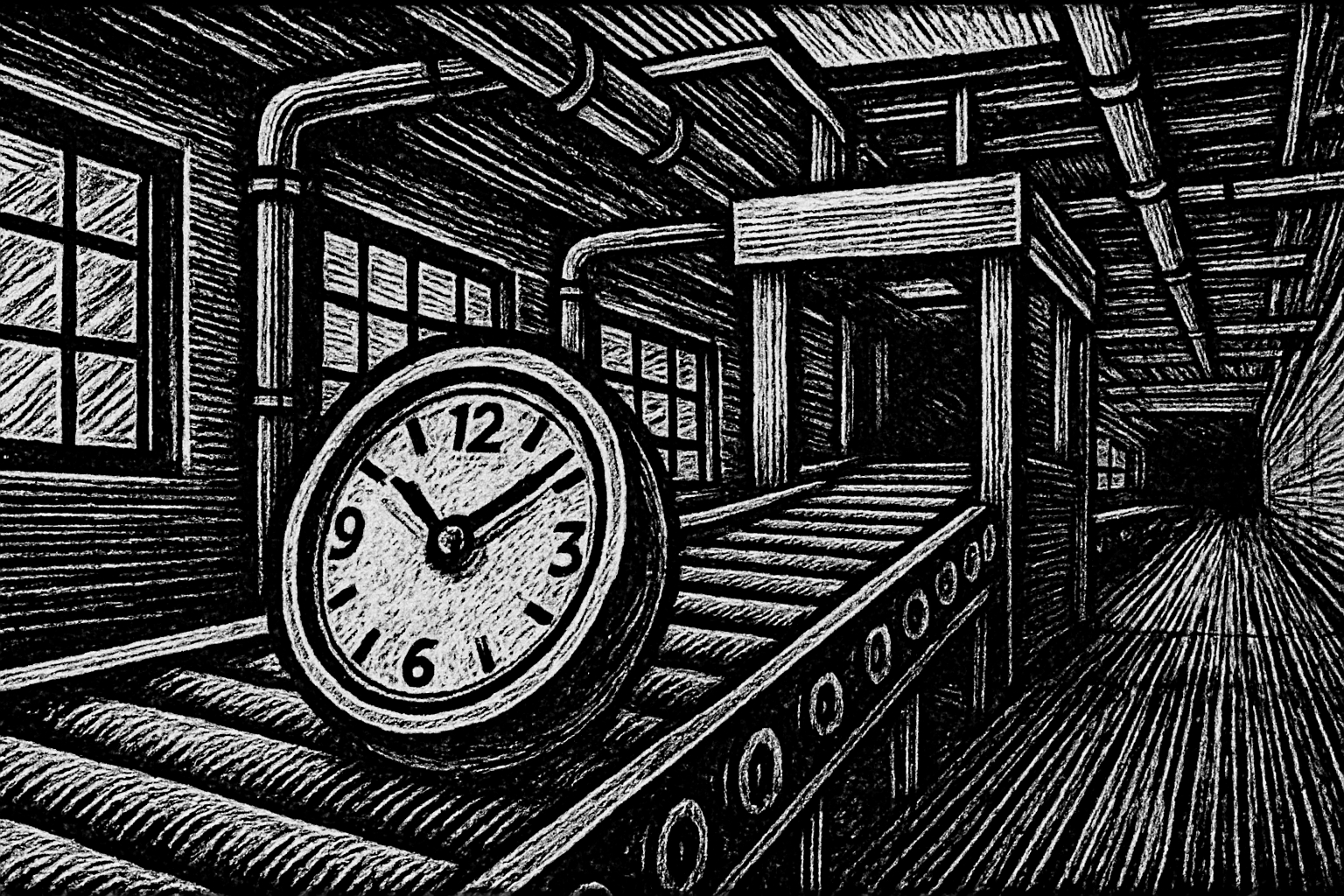
On March 1, 2050, the last clock rolled off the assembly line. There was no announcement and no ceremony. It was simply the final unit in a long lineage of devices that had shaped human life for centuries. The workers who boxed it up were finishing a shift, not closing an era, yet that quiet moment marked the end of the instrument that once defined how people organized their days.
Clocks had been with us for centuries. They shaped our mornings and carved our days into pieces. They structured our work, our meals, our meetings, and our milestones. They hung on walls and sat on wrists and glowed from screens that illuminated every room we lived in. They were so familiar that their authority felt natural. People rarely questioned the arrangement. It seemed normal to live inside their system.
Time is a river. Clocks turned it into a map. Time flowed with no regard for efficiency or lateness. It did not judge. It did not measure. Clocks changed this. They overlaid the river with boundaries and markers. They translated the day into early, late, ahead, and behind. They imposed ideas like productivity and wasted time. They created obligation where nature offered none.
For centuries, clocks were the most successful instrument of behavioral control ever invented. They overruled the signals that guided humans for hundreds of thousands of years. A hunter gatherer slept when tired, woke when rested, ate when hungry, and moved when the body leaned forward. The clock replaced those instincts with commands. Wake now. Eat now. Work now. Stop now. It told people to sit when their bodies wanted movement and to concentrate when their attention had already faded. It cut deep work into fragments and asked the mind to restart again and again. It trained entire societies to distrust internal cues. Feeling tired, curious, energized, or hungry stopped being directives. They became data points to negotiate with a schedule.
This is one side of the story. But there is another. Clocks not only disciplined individuals. They also enlarged what groups could accomplish. They solved the ancient problem of coordination at scale. Without clocks, you do not get trains that meet each other safely. You do not get surgeries that require the synchronized presence of a dozen specialists. You do not get global markets or supply chains or shared rituals that stretch across continents. Clocks allowed strangers to act in sync even when separated by distance and culture. They gave civilization a collective tempo that instinct alone could not sustain.
This created a profound tension. To gain the power of coordinated society, humanity surrendered a portion of its biological integrity. The clock became the price of the modern world. Individuals lived out of sync so that large groups could live in sync. Every benefit had a cost. The shared tempo required the personal sacrifice of natural rhythm. Civilization grew strong while individuals grew detached from their own timing.
The world ran this way for a long time. Then the superintelligence arrived. It did not appear as a single machine. It emerged as a woven presence in the systems that supported daily life. It could sense patterns far beyond human perception. It could read readiness, attention, resource flow, and alignment across entire populations. It understood when someone was truly focused, when someone needed recovery, when a team was ready to collaborate, and when an idea was ripening. It became a conductor that did not need a score. It could guide coordination without telling anyone the hour.
Superintelligence changed coordination at every scale. It could detect patterns across thousands, hundreds of thousands, or even millions of people at once. It sensed when clusters of individuals were aligned, when attention across a group was rising or falling, and when a moment of collective readiness was forming. It moved resources, tasks, and people into alignment without forcing anyone into a rigid schedule. Coordination became fluid rather than mechanical. Large groups no longer needed a clock to agree on a time. They simply converged when the shared pattern emerged.
This changed everything. Human life no longer needed the map that clocks had imposed on the river. The superintelligence handled synchronization directly, so people could finally live the way their biology had always intended. Work happened when focus naturally peaked. Conversations happened when the participants were aligned. Collaboration unfolded at the moment of shared readiness. Rest returned to its rightful place. Hunger returned to its natural cue. The pressure to negotiate with one’s own body began to fade.
People slowly returned to a rhythm that resembled the oldest human pattern we have. The hunter gatherer flow came back, not as nostalgia but as integration. It was the softness of biological timing combined with the reach of global scale cooperation. Civilization no longer needed clocks to hold itself together.
When the last clock stopped, humanity discovered that time had never been the enemy. The map had been the problem. Once the map dissolved, the river kept flowing, and people finally began to flow with it again.