The Game Your Boss Is Really Running
Most young people make the same mistake when they try to judge a boss or an employer. They look at style first. They notice confidence, energy, polish, intensity, the way a person speaks in a meeting, the way they carry themselves, the way the company presents itself, and they let those surface signals do too much of the work.
That is usually the wrong layer.
What matters more is pattern.
By pattern, I do not mean personality. I do not mean whether the boss is quiet or loud, warm or cold, charismatic or awkward. I mean the repeated logic of the place. I mean what keeps happening around that person. I mean how decisions tend to get made, how pressure gets handled, how mistakes get treated, how trust gets assigned, how often the same chaos comes back, who grows, who leaves, who gets blamed, and who actually gets better.
A young person can get fooled by style very easily. Style is visible in a single conversation. Pattern usually has to be observed. Style can charm you in an interview. Pattern is what will shape your days once you are inside.
So here is a simple framework I think is actually worth using.
Think of your boss as a game mechanic.
Whether they know it or not, every boss is setting the local rules of the game. They are shaping what gets rewarded, what gets punished, what gets ignored, what counts as winning, how much people are allowed to think, how much panic is tolerated, whether people are expected to grow, and whether the place is built to develop judgment or merely extract labor.
That matters because when you are young, you often think you are choosing a job, when in reality you are stepping into a game that is already in motion. For a season of your life, you are going to live inside that game. You are going to absorb its incentives, its habits, its pace, its standards, and its blind spots. The question is whether that game is going to enlarge you or diminish you.
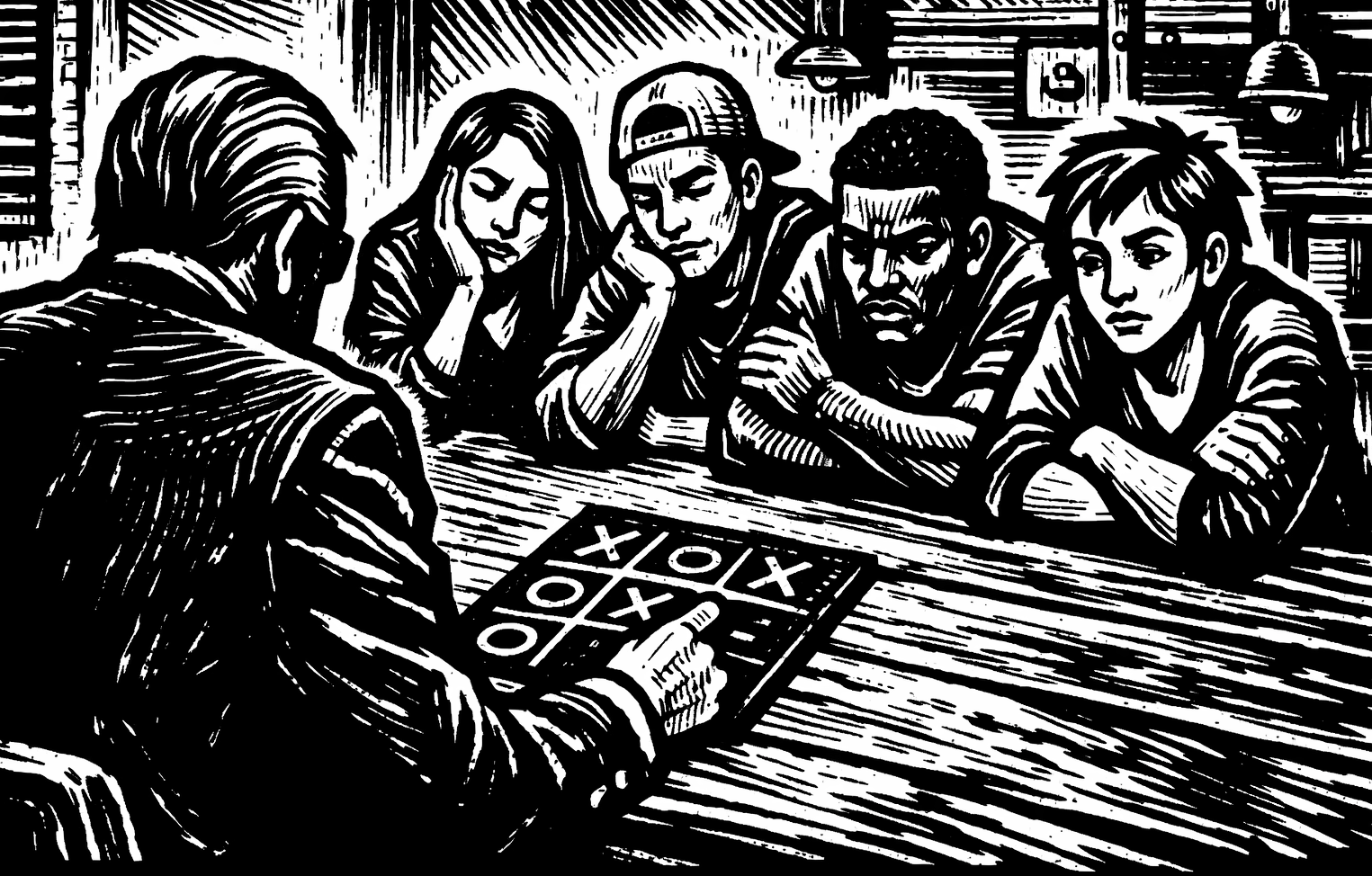
Some bosses create tic-tac-toe environments.
Everything is shallow, immediate, and overly simplified. Pressure collapses thought instead of sharpening it. The same few squares on the board get filled over and over again. Little is built. Little is learned. The place may stay busy, but it does not get much wiser.
A tic-tac-toe boss will talk about paint colors while the walls are falling down.
You can usually spot this pattern by the recurrence. The same avoidable problems keep reappearing. The boss is always surprised by things that should not be surprising anymore. People are corrected for outcomes without much attention to the conditions that produced them. Training is thin. Judgment is weak. Noise is often mistaken for action. If you spend too long in a place like that, you can become faster without becoming better.
Some bosses create checkers environments.
This is an improvement. There is more competence. There is more discipline. There is a stronger grasp of sequence, reaction, counterreaction, and immediate consequence. These leaders can often handle what is in front of them. They know how to move. They know how to recover. They know how to keep the operation from drifting into total disorder.
A checkers boss will grab a bucket every time the ceiling leaks and get very good at it.
But many checkers environments still live too close to the next move. They are tactical rather than developmental. They are better at handling motion than building strength. They may teach you execution, responsiveness, and practical awareness, which is real value, but they can still leave you living inside a short horizon where the urgent keeps beating the important.
Then there are bosses who create chess environments.
These are the people who think ahead. They understand that one decision changes the conditions for five later decisions. They care about position, timing, tradeoffs, and second-order effects. They build systems instead of endlessly compensating for the absence of systems. They do not merely ask who made the mistake. They ask why the mistake was easy to make in the first place. They do not confuse pressure with panic. They are capable of pausing long enough to see structure.
A chess boss will ask why the ceiling keeps leaking, who can fix the roof, and how to make sure the bucket stops being a permanent department.
In places like that, a young person has a chance to gain more than income. He can gain judgment. He can start to see how real decisions compound. He can learn why some people become trusted and why others remain supervised forever. He can begin to understand that responsibility is not simply doing more tasks. It is seeing more of reality, earlier, and carrying more of the consequences without becoming theatrical about it.
Then there are the builders.
These are the strongest bosses. They do not just run a high-functioning game. They build games in which younger people become stronger players over time. They do not just use young workers as available energy. They increase their value. They give them room to grow without indulging sloppiness. They correct without humiliating. They raise standards without turning the place into a fear machine. They know that building the business and building people are not separate activities.
This is why pattern matters so much.
If you want to identify the pattern, watch the environment. Watch what gets rewarded, what gets ignored, what keeps going wrong, who rises, who leaves, and whether younger people are becoming more capable or merely more tired.
Before I gave a company several years of my life, I would want to know: what kind of game are the leaders here creating, and what will playing it do to me?