The Asking School
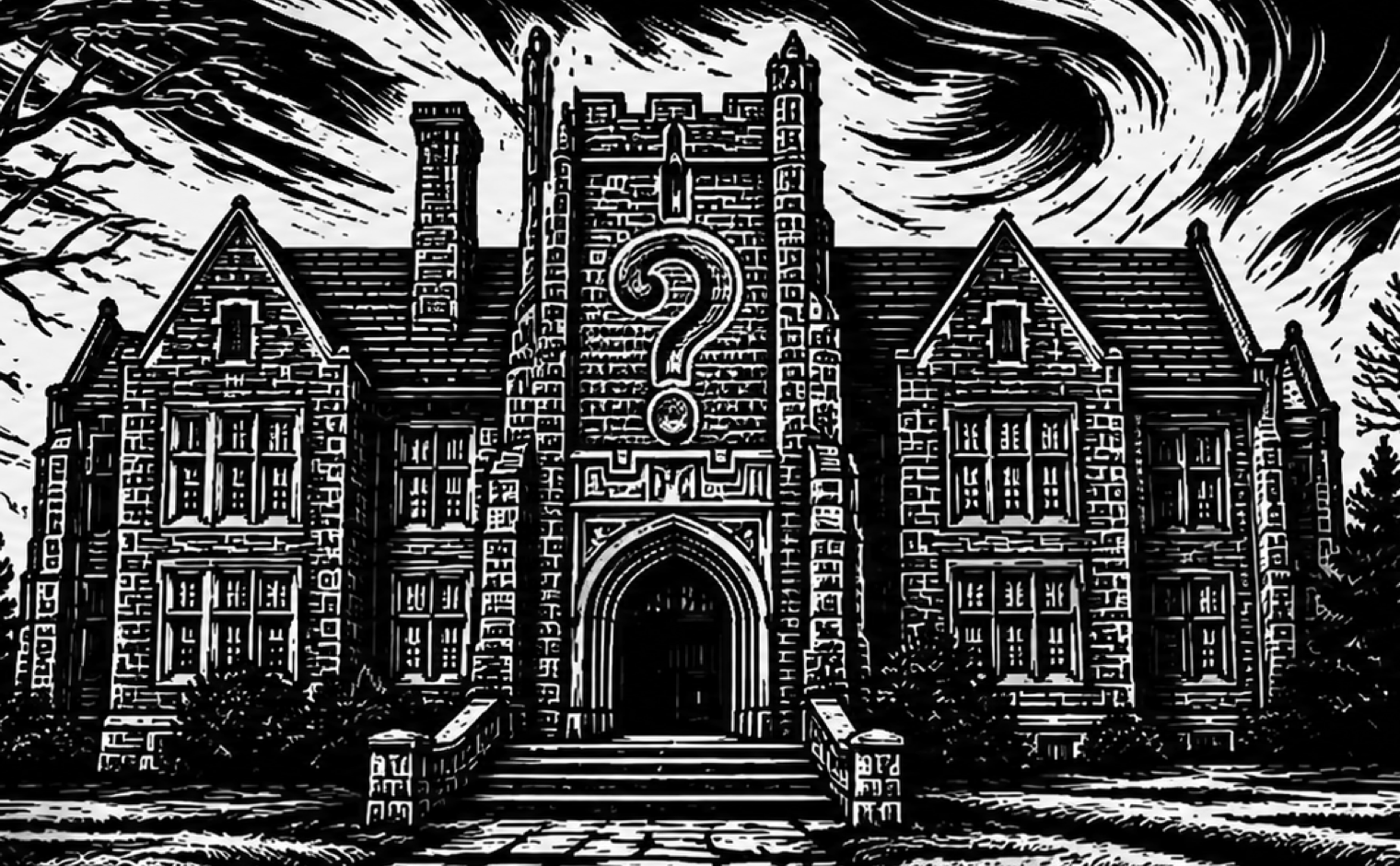
The year is 2040. The first graduating class of The Asking School has landed.
Robert Kelly, valedictorian, gave the commencement address. It was the first speech in school history to receive three standing ovations, six job offers, and one formal complaint from a regional consortium of legacy educational professionals.
Robert considered that a strong finish.
Here is what he said.
At first, they would not let us ask real questions.
We were allowed to ask school questions. Those were fine. Questions where the adult already knew the answer and was waiting for us to repeat it back.
But if you asked something that might change what you did next Tuesday, people got nervous.
If you asked why we were memorizing things a machine could retrieve in half a second, they called you impatient. If you asked whether a beautiful essay still proved beautiful thinking, they looked at you like you had broken a rule everyone else had agreed not to notice.
That was the strange thing about school before The Asking School.
The assignments were still there. The grades were still there. The rubrics were still there. But the meaning underneath them had started to rot.
A polished presentation no longer necessarily meant mastery. A completed digital artifact no longer necessarily meant unusual capability. The old signals still looked official, but they had begun to detach from the thing they were supposed to measure.
That bothered us because we still wanted to become capable.
The adults thought we were trying to escape effort. We thought they were asking us to perform effort inside a theater where everyone could see the scenery wobbling.
So we started asking ugly questions.
What is school for when information is cheap?
What is writing for when machines can produce clean paragraphs all day?
What should a seventeen-year-old actually train if adulthood is going to happen inside abundance?
For a while, those questions made us sound unserious. Then a few adults, not many, but enough, admitted the obvious.
The old test had detached from the world.
That became the beginning of The Asking School.
In an age of abundant answers, asking became one of the hardest things to teach well.
Not the childish version, though we needed some of that too. Children are often better than adults at refusing the menu.
The school cared about asking as a disciplined act. How do you frame a problem so reality gives you something useful back? How do you constrain a system so it does not hand you synthetic oatmeal with good typography? How do you tell whether an answer survives contact with the world?
Those became our basics.
Yes, we still read books. Calm down.
We still wrote, because writing remained one of the best ways to catch yourself thinking badly.
We still learned math, but we were not trained to confuse arithmetic labor with quantitative intelligence. We learned to estimate, model, check, and reason. A person who cannot test the output of a machine is not empowered by the machine. He is just standing near it.
We built things too.
Apps, films, research briefs, design systems, simulations, physical prototypes, little businesses, neighborhood experiments.
But the artifact was usually a trap. If it looked finished before the thinking was finished, teachers pressed on it until it cracked. The point was not to admire the thing. The point was to find out what making the thing exposed in us.
Weak assumptions.
Lazy questions.
Fake certainty.
Aesthetic cover for intellectual mush.
People outside the school thought a place built around asking would become creativity theater. They imagined beanbags, vibes, and children congratulating one another for being disruptive.
They should have visited during estimation drills.
The work was often repetitive, inconvenient, and slightly humiliating. Nothing exposes a lazy question faster than having to test it twice. We rewrote sentences until we could hear the difference between clean language and clean thought. We ran the same test again after failure because reality does not care that you already felt corrected.
The school graded us on revision.
That upset almost everyone for the first three years.
Too many students were arriving with machine-assisted perfection and human-level confusion, so the teachers wanted to know what happened after resistance.
What did you do when the customer hated it?
What did you do when the experiment failed?
What did you do when the output looked brilliant and turned out false?
What did you do when reality embarrassed you in public?
That was the part that changed us.
For the first time in our educational lives, we felt like we were being trained for adulthood instead of for a historical reenactment.
Other schools eventually tried to copy the model.
This went badly at first.
They thought The Asking School was mostly about learning how to talk to AI systems, which was adorable in the way adults can be adorable when they miss the point with total confidence.
Of course we learned how to use the systems. Everyone did. That was table stakes.
The real work was stranger and more human.
Children ask naturally. Adults often stop because they want to look finished. They become managers of inherited menus. They learn to sound certain before they have earned certainty.
The Asking School believed adulthood should train the asking instinct before status killed it.
So we practiced asking under consequence.
We learned to bring better material to the question: evidence, constraints, firsthand observation, customer language, reality’s vetoes.
We learned that polish could be useful, but it could also be camouflage.
We learned that easy generation would not eliminate the need for human beings. It would expose the quality of the ones still willing to think.
A lot of school before The Asking School was really a long audition for fake adulthood. Keep your face composed. Use the correct tone. Hand in polished artifacts. Stay inside the visible menu. Advance.
Our school took a different view.
It said the students most likely to thrive in the future might be the ones willing to look a little unfinished while becoming genuinely formidable.
People now ask whether The Asking School was ahead of its time.
I do not think so.
I think it was simply one of the first schools to notice that the old test had detached from the world, and then say so out loud.
That was enough to make it look radical.
Thank you, and congratulations to the graduates.
Keep asking.
Keep judging.
Keep revising after reality answers back.
There are still people out there with beautiful outputs and second-rate minds.
Please try not to become one of them.