Professional Knowledge Mining
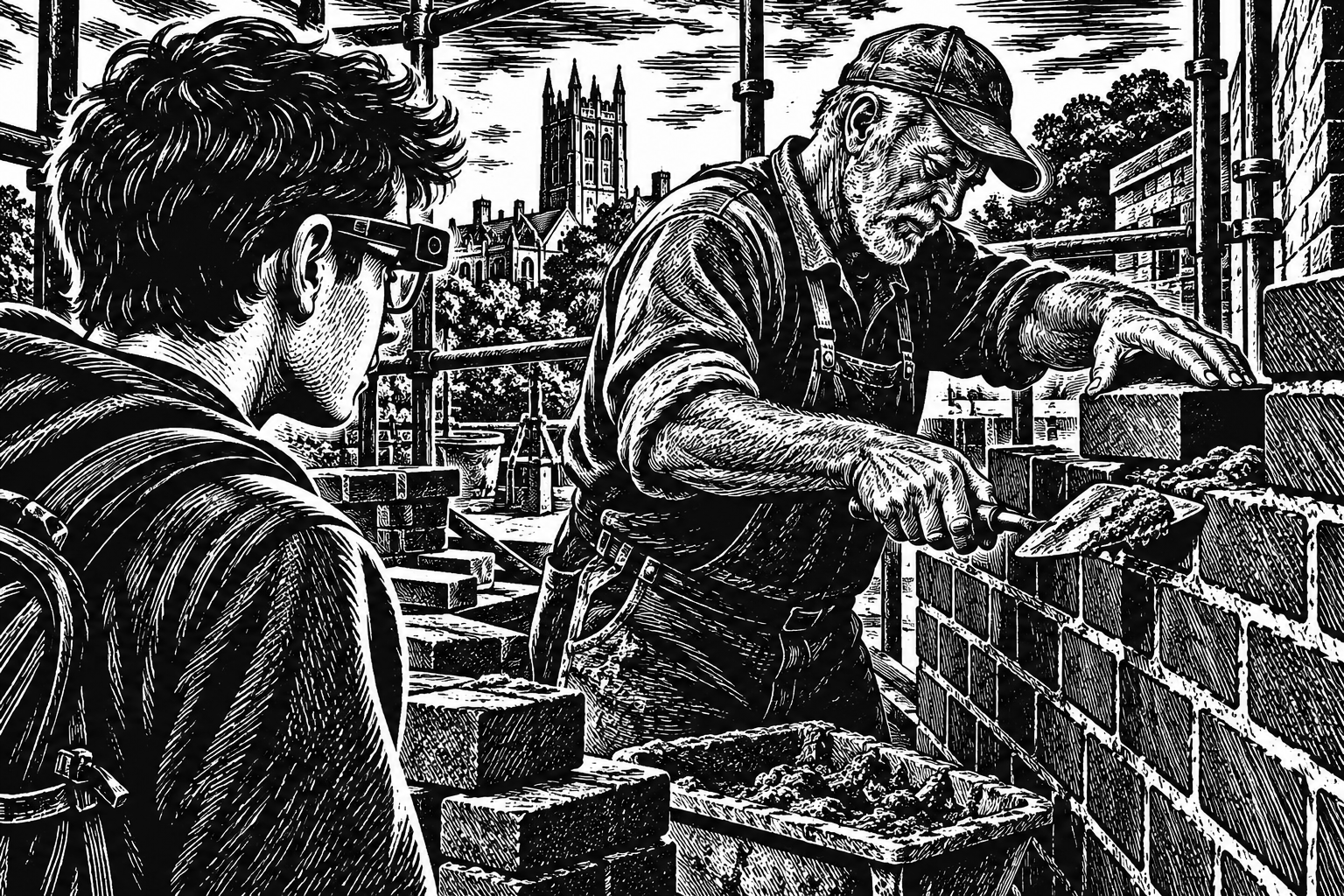
The experiment you should run before you graduate
What Do All These Areas Have in Common?
Pipe-organ tuning, commercial HVAC troubleshooting, antique clock restoration, industrial electrical maintenance, violin making and repair, commercial roofing, hand engraving, heavy-equipment repair, stained-glass conservation, elevator maintenance, wooden-boat restoration, wastewater-treatment operations, piano regulation, commercial refrigeration, stone carving, precision machining, book conservation, fire-protection systems, bell tuning, diesel diagnostics, traditional plasterwork, industrial controls, watchmaking, building-envelope restoration, scientific-instrument repair, utility line work, luthiery, manufacturing-equipment maintenance, historic masonry, municipal water systems.
Some are obscure crafts. Others are enormous industries. What they share is hard-earned knowledge that other people would pay to have, but almost nobody has figured out how to capture well.
The valuable part usually isn't the procedure in the manual. It is the judgment accumulated through thousands of real situations: which sound matters, which clue can be ignored, why the obvious repair is wrong, when to stop, what to try first, and what an experienced person notices that everyone else misses.
There may be a profession hiding inside that problem.
Call it Professional Knowledge Mining.
The job is to find expertise worth having, earn access to the people who possess it, capture their judgment while real work is happening, protect what you collect, and turn it into something useful.
If you are in university today, you could get unusually good at this before most people even realize it is a job.
Run the Experiment for 18 Months
I would not begin by choosing Professional Knowledge Mining as a career. I would run an experiment.
Pick a field you barely understand and find one or two people who are exceptionally good at it. Then spend two or three summers, or roughly 18 months of sustained effort, trying to answer one question:
Can I capture enough of their judgment to make someone else measurably better at the work?
Your first attempts will be bad. You will record the wrong things, ask weak questions, miss important moments, and organize material in ways you later abandon. By the tenth case you should be better. By the fiftieth you should be looking for things you did not even know existed at the beginning.
The experiment is iterative by design. You are learning the field at the same time you are learning how to mine knowledge from it.
Get Close Enough to See the Judgment
The technology is probably easier than the human relationship.
You are asking someone to open up decades of experience: mistakes, strange cases, professional instincts, customer situations, shortcuts, and judgments they may barely realize they possess. Give them a reason to want the experiment to work. That might mean paying them, helping their business, creating training for younger workers, preserving something they care about, or sharing future economic value.
Then get close to the actual work.
Put on a pair of Meta glasses or another wearable camera. Bring a phone, microphone, and notebook. Add whatever inexpensive instruments fit the field: perhaps a thermal camera, borescope, vibration sensor, moisture meter, or sound meter.
Do not merely interview the expert about what they know. Watch what they do when the situation is uncertain.
A technician listens twice. A mason notices something about a crack. A machinist changes a cut because something feels wrong through the tool. An expert rejects the obvious diagnosis because two small clues do not fit.
Ask what changed, what they noticed, what they think is happening, how sure they are, and what would change their mind. One question is especially useful:
What did you notice that I didn't?
Keep bringing what you capture back to the expert. Let them correct you. Eventually, if the relationship is working, something interesting may happen: instead of you hunting for cases, the expert calls and says, “You need to come see this one.”
Now you have a collaborator.
Protect It, Then Turn It Into Cases
Do not let six hours of video disappear into a folder called Tuesday.
Turn important episodes into cases. Preserve what was happening, what evidence was available, what the expert noticed, what they believed, what they did, where their reasoning might not apply, and what happened afterward.
The real value begins to appear when decisions are connected to outcomes.
“The expert thought X” is interesting. “The expert thought X, acted on it, and Y happened” is evidence.
You do not need an elaborate technical system at first. Organized files, transcripts, photographs, notes, and a simple database can take you a long way. AI can help transcribe, tag, compare, retrieve, and organize what you collect.
But do not become so excited about AI that you give away the thing you are trying to build.
Some captures may contain trade secrets, customer information, proprietary methods, drawings, personal information, or rare knowledge whose value partly depends on its remaining private. Get clear about ownership and permissions early.
And before uploading the crown jewels into an AI service, understand how that service handles your material: what it keeps, who might see it, whether it can be used to improve models, what contractual protections apply, and whether you have the right to upload it in the first place.
Protect the knowledge layer before building the intelligence layer.
Make the Knowledge Do Something
Eventually, stop admiring the collection and ask:
Who makes an expensive decision that becomes easier with access to this judgment?
Perhaps an apprentice could practice against fifty real cases before confronting them in the field. Perhaps contractors would pay for difficult diagnoses. Perhaps an inspection company could use the knowledge as a second set of eyes. Perhaps the best opportunity is simply to operate a service business whose employees become competent faster and make fewer expensive mistakes.
The first business does not need to be sophisticated software. It might be training, diagnosis, inspection, remote expertise, or the work itself.
Try to sell something early. People will happily tell you an experiment is fascinating. Asking them to pay $500 produces much better information.
If the knowledge actually changes decisions, saves time, prevents mistakes, improves quality, or makes scarce expertise available to more people, you may have something.
Then You Discover the Second Asset
Suppose the experiment works.
The obvious asset is the expertise you captured.
But something else happened along the way. You learned how to find a promising niche, identify the right practitioner, earn trust, recognize consequential moments, capture judgment, protect the material, turn messy work into useful cases, and discover what someone will pay to do with it.
You built the machine that builds the asset.
That is your knowledge-mining machinery.
Now try it somewhere else.
The method you developed around clock restoration might help you investigate industrial pumps. What you learned beside a mason might transfer to agricultural equipment. A technique developed around refrigeration diagnosis could reveal something useful in scientific instruments.
Your second experiment should be faster and better than the first. The third should improve again.
At that point, you are no longer simply accumulating expertise in one field. You are becoming professionally good at finding valuable human judgment that nobody has treated as an asset and turning it into one.
That could be a career.
It could also lead to businesses nobody can see yet.
Now Imagine Ten Years From Now
Imagine yourself high inside an old clocktower with an experienced technician and two relatively inexpensive robots.
One robot is inspecting. Another is positioning tools and components. The human still exercises judgment, but the little team accomplishes far more than one person could alone because years of accumulated cases sit behind the work.
The robots themselves are available to everyone.
What your competitors cannot simply order is everything your team has learned: the unusual failures, the expert corrections, the sounds, measurements, bad repairs, edge cases, decisions, and outcomes you spent years capturing.
The robots are not the advantage.
Knowing what they should know is the advantage.
And because you learned Professional Knowledge Mining rather than merely collecting clock knowledge, you know how to go find the next body of expertise they will need.
The Time Is Now
Experienced practitioners are retiring. Many industries remain terrible at transferring expertise. Wearables can capture what people see and hear. Sensors are cheap. AI can work across text, images, audio, video, measurements, and documents. Robotics is advancing.
Meanwhile, enormous amounts of useful human judgment remain stranded inside individual people.
If you are in university today, you do not need to know what company you want to build ten years from now.
Find something worth knowing. Find someone who knows it unusually well. Earn the relationship. Work beside them. Capture what everyone else misses. Protect it. Make it useful. Try to sell something. Then take what you learned and run the experiment again.
The downside is that after 18 months you may discover the niche was not worth pursuing.
The upside is stranger.
You may have found a profession nobody told you existed, created an asset you never knew you could own, and learned how to build the next one.
The companion field guide goes much deeper into prospecting for promising fields, structuring expert relationships, capture methods, intellectual-property protection, organizing cases, using AI carefully, testing whether knowledge transfers, business models, and running the second experiment.
Written with help from AI, shaped through iteration, and pushed toward clarity by a human who did not want the machine to settle for the obvious.